
🚚 Free delivery over ₹4,000 pan-India · we also ship worldwide · Buying in bulk? Get a quote in 24 hours →
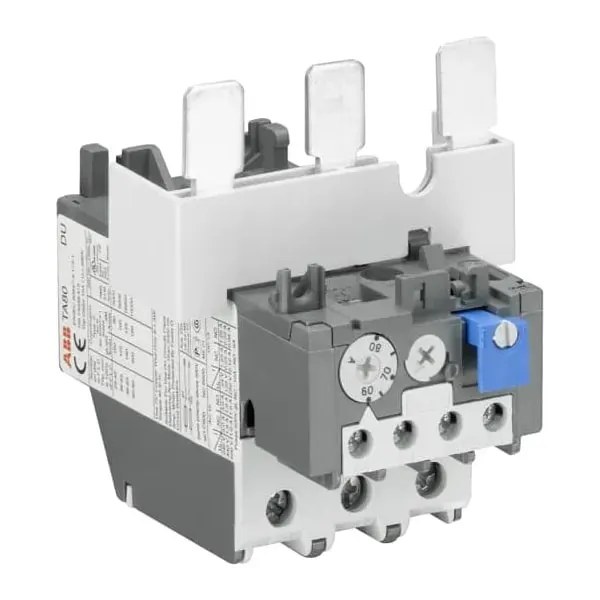
ABB TA80DU-63 Thermal Overload Relay · 1SAZ331201R10051SAZ331201R1005↓ 1% off
BrandABB
CategorySwitchgear
SpecificationThermal overload relay · 3P (TP) · 10 A · Auxiliary Circuit 440 V DC · 63 A · 45 ... 63 A
Brand SKU1SAZ331201R1005
AvailabilityOut of stock
Delivery8 to 15 business days after dispatch
ABB· Out of stock
Visit the ABB store

ABB TA80DU-63 Thermal Overload Relay · 1SAZ331201R1005

$51.47/pc-1%
$51.98
Out of stock

We list this so you can see the spec and our price, but it cannot be ordered right now. Email info@elumenuvo.com and we will source it for you.

🏷️
100% genuine
Brand-authorised stock, sourced through authorised channels
🧾
Export invoice
Every international order ships with an export invoice for customs
🌍
Worldwide delivery
Dispatched from Ghaziabad, India · fee by weight, shown at checkout
📦
Wholesale built in
Wholesale price at 15+ units: $48.90/pc on this product, applied automatically

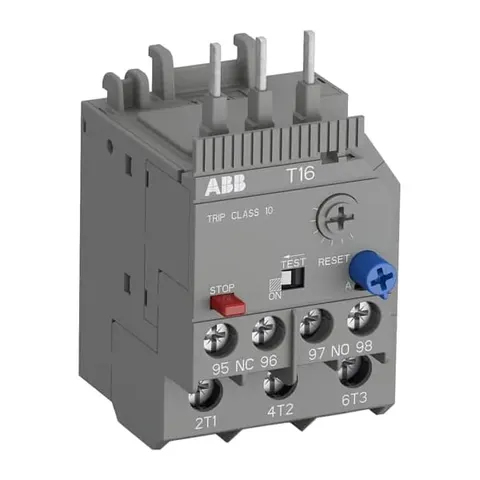
The TA80DU-63 thermal overload relay is an economic electromechanical protection device for the main circuit. It offers reliable and fast protection for motors in the event of overload or phase failure. The device has trip class 10A. Further features are the temperature compensation, trip contact (NC), signal contact (NO), automatic- or manual reset selectable, trip-free mechanism, STOP- and Test
As published by ABB. Verify critical parameters against the datasheet before specifying.
ABB ABB TA80DU-63 Thermal Overload Relay · 1SAZ331201R1005 · 1SAZ331201R1005
Device typeThermal overload relay
Poles3P (TP)
Rated current10 A
Rated voltageAuxiliary Circuit 440 V DC
FrequencyAuxiliary Circuit 50 Hz
Operational current (Ie)63 A
Setting range45 ... 63 A
Insulation voltage (Ui)690 V
Impulse withstand (Uimp)Auxiliary Circuit 6 kV
Width4.5 modules (78 mm)
Terminal capacityFlexible with Ferrule 1x 2.5 ... 25 mm²
Ingress protectionIP20
Reference standardIEC/EN 60947-1, IEC/EN 60947-4-1, IEC/EN 60947-5-1, UL 60947-1, UL 60947-4-1
Net weight0.365 kg
Current rating10 A
BrandABB
Brand SKU1SAZ331201R1005
ELINEH6C79J77M
Sold asPer pc
Ratings as published by ABB (abb.com product data; Product name). Verify critical parameters against the datasheet before specifying.
Read: Contactor Sizing for 400 V and 415 V Motors: kW to Amps, AC-3 Ratings and Overload Relays →
What size contactor do I need for a 7.5 kW motor?
A 7.5 kW three-phase motor at 400 V draws about 14.5 A, so a contactor rated at least 16 to 18 A at AC-3 is the usual choice, with an overload relay set to the nameplate current.
What is the difference between AC-1 and AC-3?
AC-1 is the rating for resistive loads such as heaters; AC-3 is the rating for switching squirrel-cage motors in normal duty. Motors are always sized on the AC-3 figure, which is lower.
How many amps per kW for a three-phase motor?
At 400 V, roughly 2 A per kW for small motors, falling towards about 1.8 A per kW above 30 kW, because larger motors run at a better power factor and efficiency. Use the nameplate for the exact figure.
What should I set the overload relay to?

Set it to the motor's full-load current from the nameplate, not higher. In a star-delta starter where the relay is in the phase winding circuit, it is set to about 0.58 times the full-load current.

Will this overload relay fit my contactor?

Most overload relays are designed to mount directly on specific contactor sizes of the same brand and range. For other brands or sizes, a separate mounting kit or panel mounting is needed, so check the compatibility list.

Does it protect against single phasing?

Most modern thermal overload relays have differential (single phasing) sensitivity and trip faster when one phase is lost, which helps protect three-phase motors. For full phase failure and phase reversal protection, a phase monitoring relay is also recommended.

What is trip class 10 and class 20?

Trip class indicates the maximum time to trip from cold at 7.2 times the set current: class 10 trips within 10 seconds and class 20 within 20 seconds (IS/IEC 60947-4-1). Class 10 suits normal motors, while class 20 or 30 is used for heavy-starting loads like crushers and fans with large inertia.

What is the difference between manual and auto reset?

In manual reset, someone must press the reset button after a trip, while auto reset lets the relay reset itself once it cools. Manual reset is generally safer, since the motor will not restart unexpectedly.

No reviews yet