

Contactor Sizing for 400 V and 415 V Motors: kW to Amps, AC-3 Ratings and Overload Relays
- Size a motor contactor by its AC-3 rating, which must be at least the motor's full-load current; the AC-1 figure is for resistive loads.
- At 400 V, a typical 4-pole motor draws roughly 2 A per kW at small sizes, falling to about 1.8 A per kW above 30 kW. The nameplate always wins.
- Match the coil voltage to the control circuit: 230 V AC, 110 V AC and 24 V DC are the common ones.
- Set the overload relay to the motor's nameplate current; in a star-delta starter the line and delta contactors carry about 58% of it.
A contactor schedule is easy to write and easy to get wrong. The panel drawing says 15 kW, the supplier asks for amps, and the catalogue shows two different current figures for the same contactor. Pick the wrong one and the contacts weld or wear out early; pick the wrong coil and the panel never pulls in at commissioning.
This guide gives a kW to amps table for three-phase motors at 400 V, explains the utilisation categories printed on every contactor, and covers coil voltages, overload relays and star-delta starters, the four things a panel builder checks before ordering.
Start from the motor's full-load current
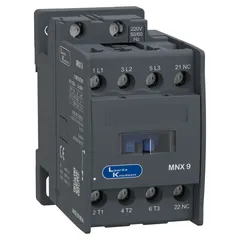
Motor current is I = P / (1.732 x V x power factor x efficiency). In practice, use the nameplate. As a guide for 4-pole three-phase induction motors at 400 V: 0.75 kW about 1.9 A, 1.5 kW about 3.4 A, 2.2 kW about 4.8 A, 3 kW about 6.4 A, 4 kW about 8.2 A, 5.5 kW about 11 A, 7.5 kW about 14.5 A, 11 kW about 21 A, 15 kW about 28 A, 18.5 kW about 34 A, 22 kW about 40 A, 30 kW about 54 A, 37 kW about 66 A, 45 kW about 80 A. At 415 V the current is a few percent lower. A 4 kW pump at 8.2 A sits comfortably on a 9 A AC-3 contactor such as the Lauritz Knudsen MNX 9 here, though many panel builders step up one size for frequent starts.
AC-3 vs AC-1: read the right column
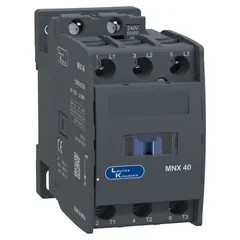
IEC 60947-4-1 rates contactors by utilisation category. AC-1 covers non-inductive or slightly inductive loads such as heaters, and gives the highest current figure. AC-3 covers squirrel-cage motors started and switched off while running, the normal motor duty, and gives a lower figure. AC-4 covers inching and plugging, the hardest duty, and lower still. A motor contactor is chosen on AC-3; using the AC-1 figure for a motor oversizes it on paper and undersizes it in reality. The Lauritz Knudsen MNX 40 here is rated 40 A at AC-3, enough for a motor of about 18.5 kW at 400 V.
Coil voltage: match the control circuit exactly
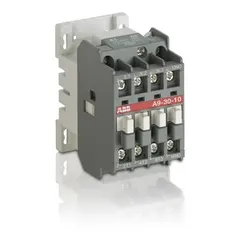
The coil is what the control circuit energises, and it must match that supply. 230 V AC suits simple panels controlled straight from the mains; 110 V AC is common where a control transformer is used for safety; 24 V DC is standard where a PLC drives the coils. Some ranges offer coils that work across a band of AC and DC voltages, which simplifies stocking. The ABB A9-30-10 here has a 400 to 415 V 50 Hz coil, the kind used when the control circuit is taken phase to phase.
The overload relay protects the motor
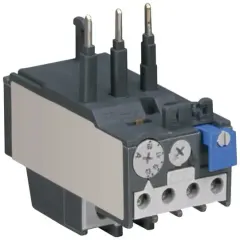
A contactor switches; it does not protect. The motor's protection against overload comes from a thermal or electronic overload relay set to the nameplate full-load current, with short-circuit protection from an MCB, MPCB or fuses upstream. Choose a relay whose setting range brackets the motor current in the middle of its range, not at an end. The ABB TA25DU-25M here covers 18 to 25 A, which fits a 11 kW motor at about 21 A.
Star-delta starters split the current
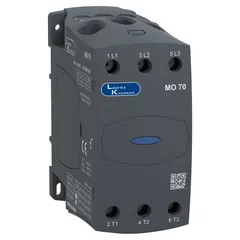
A star-delta starter uses three contactors: main, star and delta. Because the motor windings carry phase current, the main and delta contactors each carry about 58% of the motor's full-load current (1 divided by the square root of 3), and the star contactor about 33%. The overload relay, when fitted in the winding circuit after the main contactor, is also set to about 58% of full-load current. For a 37 kW motor at about 66 A, the main and delta contactors are sized for about 38 A and the star contactor for about 22 A. Larger drives step up to frames such as the Lauritz Knudsen MO 70 here, rated 70 A at AC-3.
Buying tips
- Always size from the nameplate full-load current; the table values are typical, not guaranteed for every motor.
- Choose the AC-3 rating for motors, and step up a size for frequent starting, inching or high ambient temperatures.
- List the coil voltage and frequency on every line of the schedule; it is the most common reason a contactor is returned.
- Order the overload relay with the contactor so the two match mechanically, and pick a setting range with the motor current in its middle.
- Add auxiliary contacts at the ordering stage if the panel needs interlocks or status signals; they are cheaper than a redesign later.
Frequently asked questions
What size contactor do I need for a 7.5 kW motor?
A 7.5 kW three-phase motor at 400 V draws about 14.5 A, so a contactor rated at least 16 to 18 A at AC-3 is the usual choice, with an overload relay set to the nameplate current.
What is the difference between AC-1 and AC-3?
AC-1 is the rating for resistive loads such as heaters; AC-3 is the rating for switching squirrel-cage motors in normal duty. Motors are always sized on the AC-3 figure, which is lower.
How many amps per kW for a three-phase motor?
At 400 V, roughly 2 A per kW for small motors, falling towards about 1.8 A per kW above 30 kW, because larger motors run at a better power factor and efficiency. Use the nameplate for the exact figure.
What coil voltage should I order?
The voltage of the control circuit that energises the coil: 230 V AC for mains-controlled panels, 110 V AC behind a control transformer, 24 V DC from a PLC. Frequency matters too, 50 Hz or 60 Hz.
Can Elume supply contactors and relays for a panel abroad?
Yes. Send the panel schedule with motor ratings, coil voltages and auxiliary contacts through the export desk, across ABB, Schneider, Siemens and Lauritz Knudsen, for one consolidated quote within 24 hours.
Compare MRP vs the Elume price across brands, with wholesale prices on 15+ units.
Browse the catalogue →