
🚚 Free delivery over ₹4,000 pan-India · we also ship worldwide · Buying in bulk? Get a quote in 24 hours →
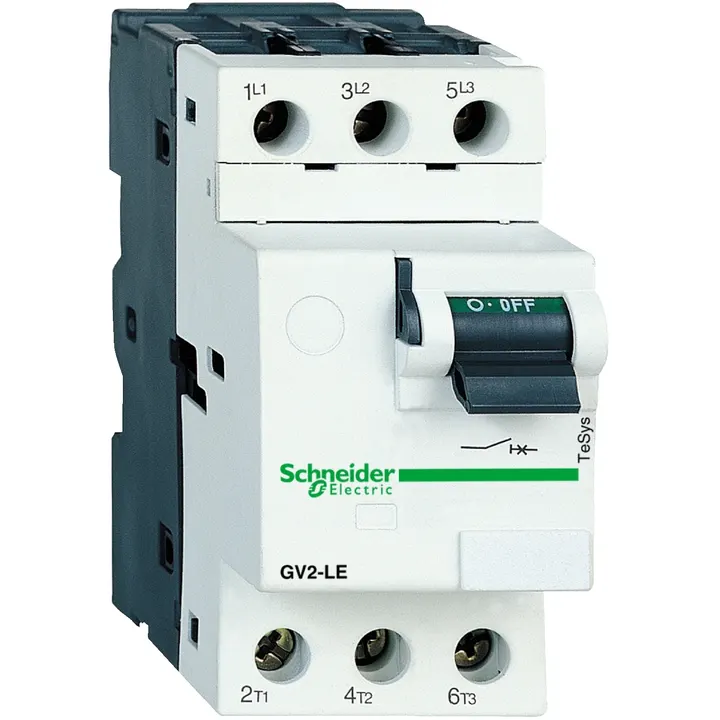
Schneider TeSys Deca GV2LE Motor Protection Circuit Breaker · 3P · 10 A · 100 kA · Dark grey · GV2LE14GV2LE14↓ 40% off
BrandSchneider
CategoryIndustrial Control
Specification3P · 100 kA
Brand SKUGV2LE14
AvailabilityIn stock · ships in 24h
Delivery8 to 15 business days after dispatch
Schneider· In stock
Visit the Schneider store

Schneider TeSys Deca GV2LE Motor Protection Circuit Breaker · 3P · 10 A · 100 kA · Dark grey · GV2LE14

$94.66/pc-40%
$157.77
Wholesale · 15+ units
$89.93 /pc
Add to cart
Buy now
Delivery in 8 to 15 business days after dispatch
Buying in bulk? Ask our Export desk for a quote.
$94.66 /pc
Delivery in 8 to 15 business days
🏷️
100% genuine
Brand-authorised stock, sourced through authorised channels
🧾
Export invoice
Every international order ships with an export invoice for customs
🌍
Worldwide delivery
Dispatched from Ghaziabad, India · fee by weight, shown at checkout
📦
Wholesale built in
Wholesale price at 15+ units: $89.93/pc on this product, applied automatically

TeSys GV motor circuit breaker, 3 poles (3P), 10A/690V, for 3-phase motor applications 3-4kW@400V. It provides a magnetic protection with a tripping level at 13xIn, high breaking capacity Icu 100kA@400V. Connection by screw clamp terminals. Start-stop control by toggle guaranteed for 100 000 cycles AC-3. To complete motor protection, use in association with a thermal overload relay LRD14 (to be ordered separately). Multi standards certified (IEC, UL, CSA, CCC, EAC, Marine), Green Premium compliant (RoHS/REACh).
As published by Schneider. Verify critical parameters against the datasheet before specifying.
Schneider Schneider TeSys Deca GV2LE Motor Protection Circuit Breaker · 3P · 10 A · 100 kA · Dark grey · GV2LE14 · GV2LE14
Poles3P (TP)
Rated current10 A
Breaking capacity100 kA
Ingress protectionIP20
Reference standardEN/IEC 60947-2
ColourDark grey
Net weight0.33 kg
BrandSchneider
Brand SKUGV2LE14
ELINEF42KGPPH7
Sold asPer pc
Depth78.5 mm
RangeTeSys Deca
Width45 mm
Height89 mm
StandardsEN/IEC 60947-2 · EN/IEC 60947-4-1 · UL 60947-4-1 · CSA C22.2 No 60947-4-1 · IEC/EN 60335-2-40:Annex JJ
Rated dutyUninterrupted conforming to IEC 60947-4-1
Fixing mode35 mm symmetrical DIN rail: clipped · Panel: screwed (with adaptor plate)
Control typeToggle
Network typeAC
Product nameTeSys GV2
Motor power kW3 kW at 400/415 V AC 50/60 Hz · 4 kW at 400/415 V AC 50/60 Hz · 4 kW at 500 V AC 50/60 Hz · 5.5 kW at 500 V AC 50/60 Hz · 5.5 kW at 690 V AC 50/60 Hz · 7.5 kW at 690 V AC 50/60 Hz
Fire resistance960 °C conforming to IEC 60695-2-11
Device short nameGV2LE
Mounting positionHorizontal · Vertical
Network frequency50/60 Hz conforming to IEC 60947-2
Poles description3P
Tightening torque1.7 N.m - on screw clamp terminal
Climatic withstandconforming to IACS E10
Device applicationMotor protection
Operating altitude<= 2000 m
[In] rated current10 A
Trip unit technologyMagnetic
Utilisation categoryCategory A conforming to IEC 60947-2 · AC-3 conforming to IEC 60947-4-1 · AC-3e conforming to IEC 60947-4-1
Electrical durability100000 cycles for AC-3 at 415 V In · 100000 cycles for AC-3e at 415 V In
Mechanical durability100000 cycles
Mechanical robustnessShocks: 30 Gn for 11 ms · Vibrations: 5 Gn, 5...150 Hz
Product certificationsCB Scheme · CE · UKCA · CCC · cULus · EAC · LROS (Lloyds register of shipping) · BV · RINA · DNV-GL
Connections - terminalsPower circuit: screw clamp terminal 2 cable(s) 1…6 mm² - solid · Power circuit: screw clamp terminal 2 cable(s) 1.5…6 mm² - flexible without cable end · Power circuit: screw clamp terminal 2 cable(s) 1…4 mm² - flexible with cable end
IK degree of protectionIK04
IP degree of protectionIP20 conforming to IEC 60529
Magnetic tripping current149 A
Product or component typeMotor circuit breaker
Suitability for isolationYes conforming to IEC 60947-1
Power dissipation per pole1.8 W
[Ui] rated insulation voltage690 V AC 50/60 Hz conforming to IEC 60947-2
[Ue] rated operational voltage690 V AC 50/60 Hz conforming to IEC 60947-2
Ambient air temperature for storage-40…80 °C
Ambient air temperature for operation-20…60 °C
[Uimp] rated impulse withstand voltage6 kV conforming to IEC 60947-2
[Ith] conventional free air thermal current10 A conforming to IEC 60947-2
[Ics] rated service short-circuit breaking capacity100 % at 230/240 V AC 50/60 Hz conforming to IEC 60947-2 · 100 % at 400/415 V AC 50/60 Hz conforming to IEC 60947-2 · 100 % at 440 V AC 50/60 Hz conforming to IEC 60947-2 · 100 % at 500 V AC 50/60 Hz conforming to IEC 60947-2 · 75 % at 690 V AC 50/60 Hz conforming to IEC 60947-2
Ratings as published by Schneider (se.com). Verify critical parameters against the datasheet before specifying.
Other Schneider ranges and models in this category, closest in price to this one.
What is the difference between MPCB and MCB for a motor?

An MPCB has an adjustable overload setting matched to the motor's current and a magnetic trip set to handle motor starting current, plus phase loss sensitivity. An MCB has fixed overload settings meant for cables, so it does not protect a motor as precisely (MPCBs are covered by IS/IEC 60947-2 and 60947-4-1).

Can an MPCB replace an overload relay and fuses?

Yes, an MPCB gives short-circuit and overload protection plus isolation in one device, so with a contactor it forms a compact DOL starter without a separate overload relay or fuses. Check the manufacturer's coordination table for the right contactor pairing.

Can I start and stop the motor directly with the MPCB?

Yes, an MPCB can be used as a manual motor starter for occasional on/off switching. For frequent starts, remote control or float/pressure switch operation, pair it with a contactor.

Which accessories are available for an MPCB?

Common accessories include auxiliary contacts, trip-indication contacts, undervoltage and shunt releases, enclosures for wall mounting and connection links to contactors. These are usually specific to the MPCB range.

My MPCB trips when the motor starts - what should I check?

Check that the dial is set to the motor's full-load current, that all three phases are present and balanced, and that the pump or load is not jammed. If the motor current is near the top of the range, the next range up may be needed; consult an electrician before increasing settings.

No reviews yet