

 A9N26597↓ 40% off

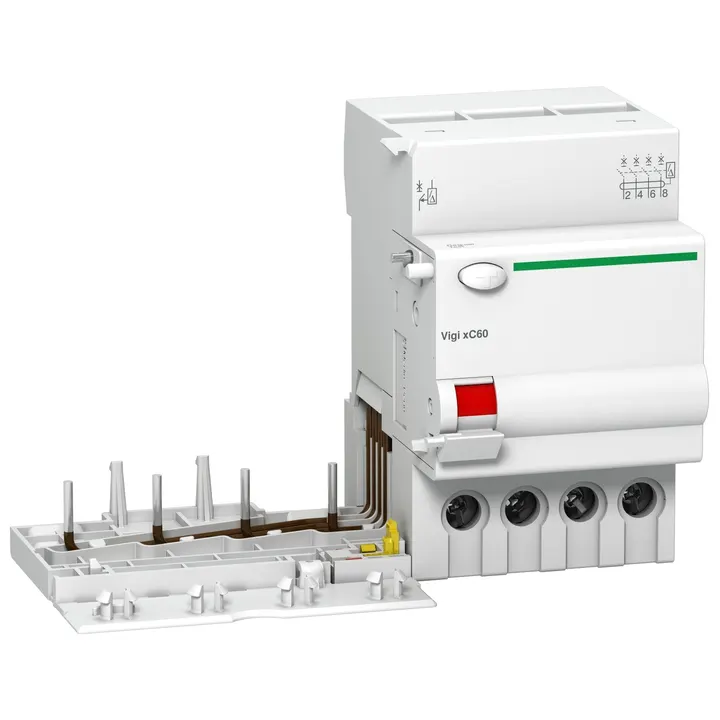
Schneider Acti9 Vigi xC60 Vigi Add-on RCD · 4P · 25 A · 300 mA · A9N26597
This Acti9 Vigi xC60 is a modular add-on residual current devices. It is a 4P and rated current is 25A. The earth leakage protection class is AC type with a sensitivity of 300mA and a electromechanical technology. This product protects against short circuit, cable overload, electrical shock by indirect contact and fire hazards. This product is compliant with EN/IEC 61009-1 and EN/IEC 61009-2-1 standard. The Ue rated operational voltage is from 400VAC to 415VAC. The Ui rated insulation voltage is 500VAC. The Uimp rated impulse withstand voltage is 6kV. The pollution degree is 3. It can be mounted on DIN rail. The width in 9mm pitches is 6. The dimensions are (W) 126mm x (H) 87mm x (D) 74.5mm. The weight is 215g. The degree of protection is IP20 and IP40 in an enclosure. The operating temperature is -5°C to 60°C. The storage temperature is -40°C to 85°C.
Is 30mA or 100mA RCCB right for home?
For protecting people from shock, use 30mA on circuits feeding sockets, bathrooms, kitchens and outdoor points. 100mA or 300mA RCCBs are mainly for fire protection and are often used upstream as a main device, with 30mA protection on the final circuits.
What sensitivity is this RCCB?
This RCCB trips at a residual (leakage) current of 300 mA. 30mA is the standard for personal shock protection, while 100mA and 300mA are used for equipment and fire protection.
Does an RCCB need an MCB with it?
Yes. An RCCB only detects earth leakage and does not protect against overload or short circuit, so it must be backed up by an MCB or fuse of a rating given in the manufacturer's data (RCCBs are covered by IS 12640 (Part 1)).
Why does my RCCB keep tripping?
Common causes are genuine leakage from a faulty appliance (often a geyser element, pump or washing machine), moisture in wiring, neutral of one circuit being shared with another, or many electronic loads adding up their small leakages. Switch off all MCBs and turn them on one by one to find the culprit circuit, and have an electrician test insulation; never bypass the RCCB.
What is the difference between Type AC and Type A RCCB?
Type AC detects only sinusoidal AC leakage, while Type A also detects pulsating DC leakage produced by electronic loads like inverter ACs, washing machines, induction cooktops and LED drivers. Type A is the safer choice for modern homes with many electronic appliances; EV chargers and VFDs may need Type B or a charger with built-in DC detection.
Is this a 2 pole or 4 pole RCCB?
The pole configuration of this RCCB is 4P. 2 pole is used on single-phase supply and 4 pole on three-phase supply with neutral, and the neutral of every protected circuit must pass through the same RCCB.
How often should I press the test button?
Manufacturers commonly recommend pressing the test button regularly, often once a month; check the interval in the product's instructions. The RCCB should trip immediately, and if it does not, have an electrician check and replace it.
What current rating RCCB do I need - 25A, 40A or 63A?
The RCCB's rated current should be equal to or higher than the MCB or main switch feeding it, because it must carry the full load current. Many Indian homes use 40A or 63A RCCBs at the incomer; for a single circuit, 25A is common.