
🚚 Free delivery over ₹4,000 pan-India · we also ship worldwide · Buying in bulk? Get a quote in 24 hours →
Schneider TeSys LR9D Thermal Overload Relay · 1.6-8 A · LR9D08LR9D08↓ 40% off
BrandSchneider
CategoryIndustrial Control
Specification1.6…8 A
Brand SKULR9D08
AvailabilityIn stock · ships in 24h
Delivery8 to 15 business days after dispatch
Schneider· In stock
Visit the Schneider store

Schneider TeSys LR9D Thermal Overload Relay · 1.6-8 A · LR9D08

Setting: 1.6…8 A
$205.86/pc-40%
$343.10
Wholesale · 15+ units
$195.57 /pc
Add to cart
Buy now
Delivery in 8 to 15 business days after dispatch
Buying in bulk? Ask our Export desk for a quote.
$205.86 /pc
Delivery in 8 to 15 business days
🏷️
100% genuine
Brand-authorised stock, sourced through authorised channels
🧾
Export invoice
Every international order ships with an export invoice for customs
🌍
Worldwide delivery
Dispatched from Ghaziabad, India · fee by weight, shown at checkout
📦
Wholesale built in
Wholesale price at 15+ units: $195.57/pc on this product, applied automatically

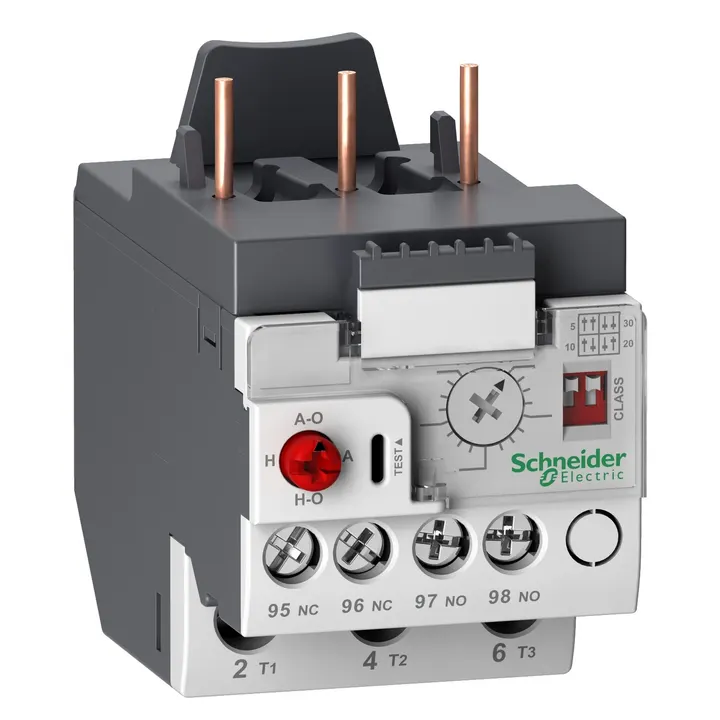
TeSys LR9D electronic overload relay, 8A/690V, thermal setting range 1.6-8A, selectable tripping class 5-10-20-30, for protection of 3-phase motors 0.75-3kW@400V. Differential device with phase failure and load unbalance detection. It provides a thermal adjustement dial, buttons for test, stop and reset as well as manual-automatic reset selector, dipswitches for tripping class selection, a flag indicator and 2 auxiliary contacts 1NO+1NC for fault signalling. Settings are protected by a transparent cover lockable by sealing. Connection by screw clamp terminals, it connects directly to the bottom terminals of 3-pole contactors LC1D09-D38. Mounting on DIN rail or screw fixing, separated from contactor, with use of the terminal block LAD7B205 (to be ordered separately). Multi-standards certified (IEC, UL, CSA, CCC), Green Premium compliant (RoHs/Reach).
As published by Schneider. Verify critical parameters against the datasheet before specifying.
Schneider Schneider TeSys LR9D Thermal Overload Relay · 1.6-8 A · LR9D08 · LR9D08
Ingress protectionIP20 front face
Reference standardEN/IEC 60947-4-1
Net weight0.18 kg
BrandSchneider
Brand SKULR9D08
ELINEJ6C2PKJC7
Sold asPer pc
Depth79.9 mm
RangeTeSys
Width45 mm
Height72.5 mm
StandardsEN/IEC 60947-4-1 · EN/IEC 60947-5-1 · UL 60947-4-1 · UL 60947-5-1 · CSA C22.2 No 60947-4-1 · CSA C22.2 No 60947-5-1 · GB/T 14048.4 · GB/T 14048.5
Time range1.5...4 min - automatic reset time
Control typeRed push-button: stop and manual reset · White 2 microswitches: adjustable trip class · Red knob: automatic reset · White dial: full-load current adjustment
Product nameTeSys LRD
Mounting supportUnder contactor · Plate, with specific accessories · Rail, with specific accessories
Device short nameLR9D
Relay applicationMotor protection
Tightening torqueControl circuit: 0.8 N.m on screw clamp terminals · Power circuit: 3.1 N.m on screw clamp terminals
Operating altitude2000 m without derating
Tripping threshold1.25 In conforming to IEC 60947-4-1
Dielectric strength6 kV 50 Hz conforming to IEC 60255-5
Mechanical robustnessVibrations 10...150 Hz: 6 Gn conforming to IEC 60068-2-6 · Shocks 11 ms: 15 gn conforming to IEC 60068-2-7
Product compatibilityLC1D12 · LC1D32 · LC1D38 · LC1D09 · LC1D25 · LC1D18
Associated fuse rating5 A gG for signalling circuit · 5 A BS for signalling circuit
Power consumption in W300 mW
Product certificationsIECEE CB Scheme · UL · CSA · CCC
Thermal overload classClass 5…30
Connections - terminalsControl circuit: screw clamp terminals 1 cable 2.5 mm² - cable stiffness: solid or flexible - without cable end · Power circuit: screw clamp terminals 1 cable 16 mm² - cable stiffness: solid or flexible - without cable end
IP degree of protectionIP20 front face conforming to IEC 60529
Phase failure sensitivityPhase difference > 40% 3 s conforming to IEC 60947-4-1
Product or component typeElectronic thermal overload relay
Electromagnetic compatibilitySurge withstand: 2 kV common mode conforming to IEC 61000-4-5 · Resistance to electrostatic discharge: 8 kV conforming to IEC 61000-4-2 · Immunity to radiated radio-electrical interference: 10 V/m conforming to IEC 61000-4-3 · Immunity to fast transients: 2 kV conforming to IEC 61000-4-4
[Ui] rated insulation voltagePower circuit: 1000 V · Signalling circuit: 690 V
[Ue] rated operational voltage690 V for power circuit · 660 V for signalling circuit
Ambient air temperature for storage-55…80 °C
Thermal protection adjustment range1.6…8 A
Ambient air temperature for operation-25…70 °C conforming to IEC 60255-8
[Uimp] rated impulse withstand voltage6 kV
[Ith] conventional free air thermal current5 A for signalling circuit
Ratings as published by Schneider (se.com). Verify critical parameters against the datasheet before specifying.
What should I set the overload relay to?

Set it to the motor's full-load current from the nameplate, not higher. In a star-delta starter where the relay is in the phase winding circuit, it is set to about 0.58 times the full-load current.

Will this overload relay fit my contactor?

Most overload relays are designed to mount directly on specific contactor sizes of the same brand and range. For other brands or sizes, a separate mounting kit or panel mounting is needed, so check the compatibility list.

Does it protect against single phasing?

Most modern thermal overload relays have differential (single phasing) sensitivity and trip faster when one phase is lost, which helps protect three-phase motors. For full phase failure and phase reversal protection, a phase monitoring relay is also recommended.

What is trip class 10 and class 20?

Trip class indicates the maximum time to trip from cold at 7.2 times the set current: class 10 trips within 10 seconds and class 20 within 20 seconds (IS/IEC 60947-4-1). Class 10 suits normal motors, while class 20 or 30 is used for heavy-starting loads like crushers and fans with large inertia.

What is the difference between manual and auto reset?

In manual reset, someone must press the reset button after a trip, while auto reset lets the relay reset itself once it cools. Manual reset is generally safer, since the motor will not restart unexpectedly.

No reviews yet