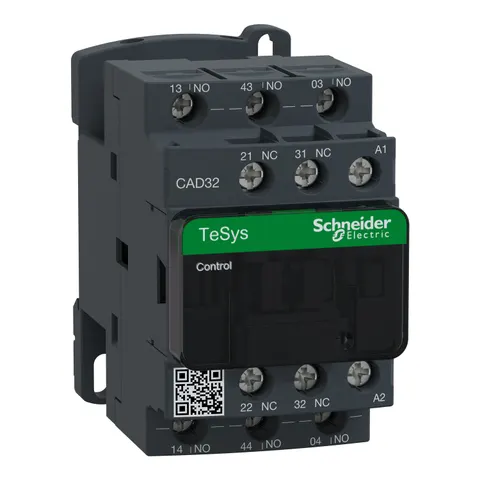
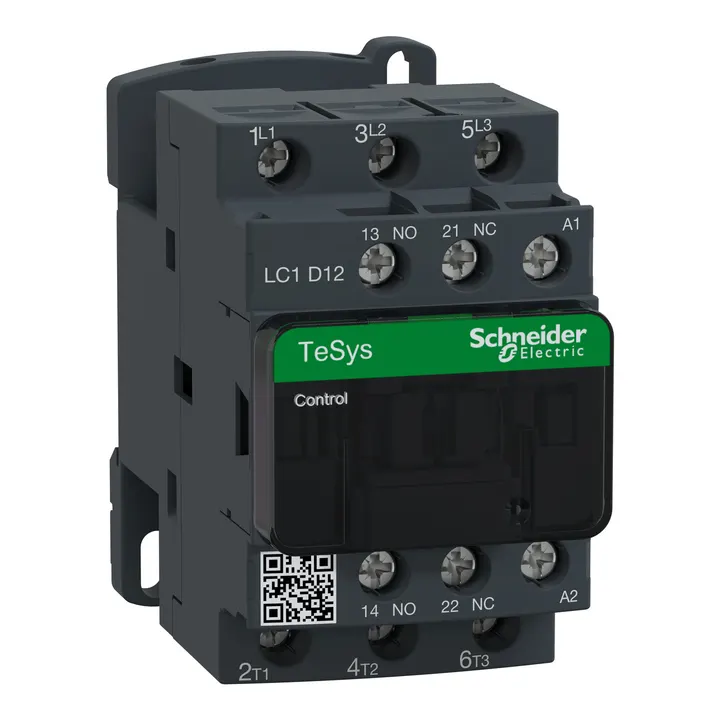
Schneider Schneider TeSys Deca Advanced LC1D Power Contactor · 3P · 25 A AC-3 · 1 NO + 1 NC aux · IP20 · LC1D12F7 · LC1D12F7
Poles3P (TP)
Rated current25 A
Ingress protectionIP20 front face
Reference standardCSA C22.2 No 14
coil voltage110 V AC 50/60 Hz
Net weight0.325 kg
BrandSchneider
Brand SKULC1D12F7
ELINEFH7R6HD2M
Sold asPer pc
Motor power hp0.5 hp at 115 V AC 50/60 Hz for 1 phase motors · 2 hp at 230/240 V AC 50/60 Hz for 1 phase motors · 3 hp at 200/208 V AC 50/60 Hz for 3 phases motors · 3 hp at 230/240 V AC 50/60 Hz for 3 phases motors · 7.5 hp at 460/480 V AC 50/60 Hz for 3 phases motors · 10 hp at 575/600 V AC 50/60 Hz for 3 phases motors
Motor power kW3 kW at 220/230 V AC 50/60 Hz (AC-3) · 5.5 kW at 380/400 V AC 50/60 Hz (AC-3) · 5.5 kW at 415/440 V AC 50/60 Hz (AC-3) · 7.5 kW at 500 V AC 50/60 Hz (AC-3) · 7.5 kW at 660/690 V AC 50/60 Hz (AC-3) · 3 kW at 220/230 V AC 50/60 Hz (AC-3e) · 5.5 kW at 380/400 V AC 50/60 Hz (AC-3e) · 5.5 kW at 415/440 V AC 50/60 Hz (AC-3e) · 7.5 kW at 500 V AC 50/60 Hz (AC-3e) · 7.5 kW at 660/690 V AC 50/60 Hz (AC-3e)
Operating time12...22 ms closing · 4...19 ms opening
Coil technologyWithout built-in suppressor module
Heat dissipation2…3 W at 50/60 Hz
Non-overlap time1.5 ms on de-energisation between NC and NO contact · 1.5 ms on energisation between NC and NO contact
Pollution degree3
Protective coverWith
Range of productTeSys Deca Advanced
Average impedance2.5 mOhm - Ith 25 A 50 Hz for power circuit
Device short nameLC1D
Poles description3P
Tightening torquePower circuit: 1.7 N.m - on screw clamp terminals - with screwdriver flat Ø 6 mm · Power circuit: 1.7 N.m - on screw clamp terminals - with screwdriver Philips No 2 · Control circuit: 1.7 N.m - on screw clamp terminals - with screwdriver flat Ø 6 mm · Control circuit: 1.7 N.m - on screw clamp terminals - with screwdriver Philips No 2 · Control circuit: 1.7 N.m - on screw clamp terminals - with scr
Compatibility codeLC1D
Inrush power in VA70 VA 60 Hz cos phi 0.75 (at 20 °C) · 70 VA 50 Hz cos phi 0.75 (at 20 °C)
Control circuit typeAC at 50/60 Hz standard
Overvoltage categoryIII
Utilisation categoryAC-3 · AC-3e · AC-1 · AC-4
Contactor applicationResistive load · Motor control
Electrical durability2 Mcycles 12 A AC-3 at Ue <= 440 V · 0.8 Mcycles 25 A AC-1 at Ue <= 440 V · 2 Mcycles 12 A AC-3e at Ue <= 440 V
Insulation resistance> 10 MOhm for signalling circuit
Mechanical durability15 Mcycles
Associated fuse rating10 A gG for signalling circuit conforming to IEC 60947-5-1 · 40 A gG at <= 690 V coordination type 1 for power circuit · 25 A gG at <= 690 V coordination type 2 for power circuit
Maximum operating rate3600 cyc/h at 60 °C
Auxiliary contacts typetype mechanically linked 1 NO + 1 NC conforming to IEC 60947-5-1 · type mirror contact 1 NC conforming to IEC 60947-4-1
Connections - terminalsPower circuit: screw clamp terminals 1 1…4 mm² - cable stiffness: flexible without cable end · Power circuit: screw clamp terminals 2 1…4 mm² - cable stiffness: flexible without cable end · Power circuit: screw clamp terminals 1 1…4 mm² - cable stiffness: flexible with cable end · Power circuit: screw clamp terminals 2 1…2.5 mm² - cable stiffness: flexible with cable end · Power circuit: screw cla
Rated breaking capacity250 A at 440 V for power circuit conforming to IEC 60947
Pole contact composition3 NO
Safety reliability levelB10d = 1369863 cycles contactor with nominal load conforming to EN/ISO 13849-1 · B10d = 20000000 cycles contactor with mechanical load conforming to EN/ISO 13849-1
Minimum switching current5 mA for signalling circuit
Minimum switching voltage17 V for signalling circuit
Product or component typeContactor
Irms rated making capacity250 A at 440 V for power circuit conforming to IEC 60947 · 140 A AC for signalling circuit conforming to IEC 60947-5-1 · 250 A DC for signalling circuit conforming to IEC 60947-5-1
Power dissipation per pole0.36 W AC-3 · 1.56 W AC-1 · 0.36 W AC-3e
Signalling circuit frequency25...400 Hz
[Uc] control circuit voltage110 V AC 50/60 Hz
Auxiliary contact composition1 NO + 1 NC
[Ui] rated insulation voltagePower circuit: 690 V conforming to IEC 60947-4-1 · Power circuit: 600 V CSA certified · Power circuit: 600 V UL certified · Signalling circuit: 690 V conforming to IEC 60947-1 · Signalling circuit: 600 V CSA certified · Signalling circuit: 600 V UL certified
Control circuit voltage limits0.3...0.6 Uc (-40…70 °C):drop-out AC 50/60 Hz · 0.8...1.1 Uc (-40…60 °C):operational AC 50 Hz · 0.85...1.1 Uc (-40…60 °C):operational AC 60 Hz · 1...1.1 Uc (60…70 °C):operational AC 50/60 Hz
[Ie] rated operational current25 A (at <60 °C) at <= 440 V AC AC-1 for power circuit · 12 A (at <60 °C) at <= 440 V AC AC-3 for power circuit · 12 A (at <60 °C) at <= 440 V AC AC-3e for power circuit
[Ue] rated operational voltagePower circuit: <= 690 V AC 25...400 Hz · Power circuit: <= 300 V DC
Hold-in power consumption in VA7.5 VA 60 Hz cos phi 0.3 (at 20 °C) · 7 VA 50 Hz cos phi 0.3 (at 20 °C)
[Uimp] rated impulse withstand voltage6 kV conforming to IEC 60947
[Icw] rated short-time withstand current105 A 40 °C - 10 s for power circuit · 210 A 40 °C - 1 s for power circuit · 30 A 40 °C - 10 min for power circuit · 61 A 40 °C - 1 min for power circuit · 100 A - 1 s for signalling circuit · 120 A - 500 ms for signalling circuit · 140 A - 100 ms for signalling circuit
[Ith] conventional free air thermal current25 A (at 60 °C) for power circuit · 10 A (at 60 °C) for signalling circuit
Ratings as published by Schneider (se.com). Verify critical parameters against the datasheet before specifying.


 LC1D12F7↓ 40% off1 / 8