
🚚 Free delivery over ₹4,000 pan-India · we also ship worldwide · Buying in bulk? Get a quote in 24 hours →
Schneider TeSys LRD Thermal Overload Relay · 62-80 A · LRD380LRD380↓ 40% off1 / 4
BrandSchneider
CategoryIndustrial Control
Specification62…80 A
Brand SKULRD380
AvailabilityIn stock · ships in 24h
Delivery8 to 15 business days after dispatch
Schneider· In stock
Visit the Schneider store

Schneider TeSys LRD Thermal Overload Relay · 62-80 A · LRD380

Setting: 62…80 A
$166.96/pc-40%
$278.27
Wholesale · 15+ units
$158.61 /pc
Add to cart
Buy now
Delivery in 8 to 15 business days after dispatch
Buying in bulk? Ask our Export desk for a quote.
$166.96 /pc
Delivery in 8 to 15 business days
🏷️
100% genuine
Brand-authorised stock, sourced through authorised channels
🧾
Export invoice
Every international order ships with an export invoice for customs
🌍
Worldwide delivery
Dispatched from Ghaziabad, India · fee by weight, shown at checkout
📦
Wholesale built in
Wholesale price at 15+ units: $158.61/pc on this product, applied automatically

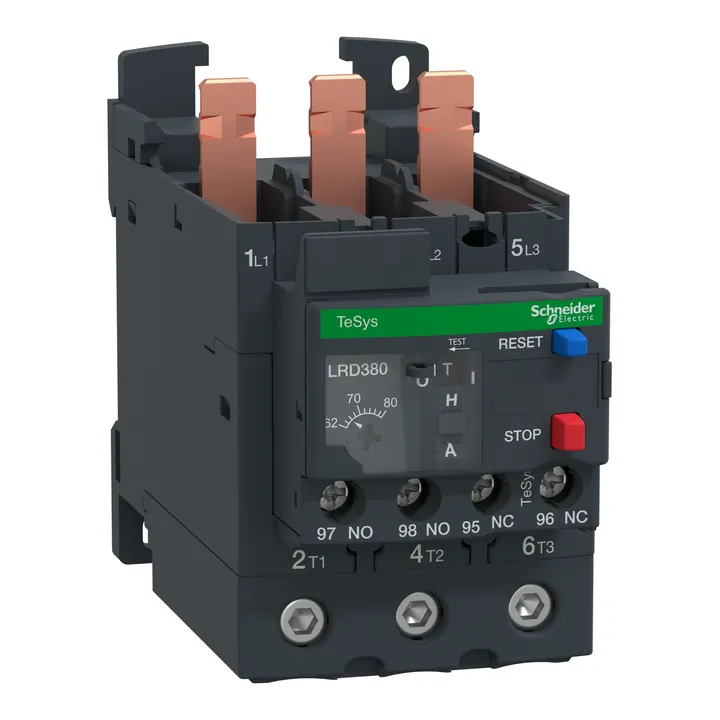
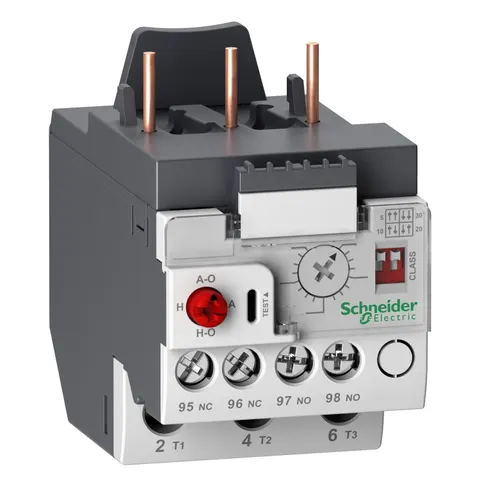
TeSys LRD thermal overload relay, 80A/690V, thermal setting range 62-80A, tripping class 10A, for protection of 3-phase motors 37kW@400V. Differential device with phase failure and load unbalance detection. It provides a thermal adjustement dial, a manual-automatic reset selector, a test selector for simulation of a tripping, reset and stop buttons, a flag indicator and 2 auxiliary contacts 1NO+1NC for fault signalling. Settings are protected by a transparent cover lockable by sealing. Connection by EverLink BTR screw terminals , it connects directly to the bottom terminals of 3-pole contactors LC1D40A-D80A. Mounting on DIN rail or screw fixing, separated from the contactor, with use of a terminal block LAD96560 (to be ordered separately). Multi standards certified (IEC, UL, CSA, CCC, EAC, Marine), Green Premium compliant (RoHs/Reach).
As published by Schneider. Verify critical parameters against the datasheet before specifying.
Schneider Schneider TeSys LRD Thermal Overload Relay · 62-80 A · LRD380 · LRD380
Ingress protectionIP20
Reference standardEN/IEC 60947-4-1
Net weight0.375 kg
BrandSchneider
Brand SKULRD380
ELINED42GD7JMP
Sold asPer pc
Depth123 mm
RangeTeSys · TeSys Deca
Width55 mm
Height70 mm
StandardsEN/IEC 60947-4-1 · EN/IEC 60947-5-1 · UL 60947-4-1 · UL 60947-5-1 · CSA C22.2 No 60947-4-1 · CSA C22.2 No 60947-5-1 · GB/T 14048.4 · GB/T 14048.5
Control typeRed push-button: stop · Blue push-button: reset
Network typeAC · DC
Product nameTeSys LRD · TeSys Deca
Flame retardanceV1 conforming to UL 94
Mounting supportPlate, with terminal block LAD96560 on top · Rail, with terminal block LAD96560 on top · Direct mounting under contactor
Device short nameLRD
Network frequency0...400 Hz
Relay applicationMotor protection
Tightening torqueControl circuit: 1.7 N.m - on screw clamp terminals · Power circuit: 5 N.m - on EverLink BTR screw connectors - cable 25 mm² · Power circuit: 8 N.m - on EverLink BTR screw connectors - cable 35 mm²
Climatic withstandconforming to IACS E10
Tripping threshold1.14 +/- 0.06 Ir conforming to IEC 60947-4-1
Dielectric strength1.89 kV at 50 Hz conforming to IEC 60947-1
Permissible current0.95 A at 380 V AC-15 for signalling circuit · 0.06 A at 440 V DC-13 for signalling circuit
Mechanical robustnessShocks: 15 Gn for 11 ms conforming to IEC 60068-2-7 · Vibrations: 3 GN conforming to IEC 60068-2-6
Product compatibilityLC1D80A
Associated fuse rating4 A gG for signalling circuit · 4 A BS for signalling circuit
Product certificationsIEC · UL · CSA · CCC · EAC · DNV-GL · RMRS · EU-RO MR · UKCA
Thermal overload classClass 10A conforming to IEC 60947-4-1
Connections - terminalsControl circuit: screw clamp terminals 2 cable(s) 1…2.5 mm² flexible with cable end · Power circuit: EverLink BTR screw connectors 1 cable(s) 1…35 mm² flexible with cable end · Power circuit: EverLink BTR screw connectors 1 cable(s) 1…35 mm² solid · Control circuit: screw clamp terminals 2 cable(s) 1…2.5 mm² solid · Control circuit: screw clamp terminals 2 cable(s) 1…2.5 mm² flexible · Power circu
IP degree of protectionIP20 conforming to IEC 60529
Temperature compensation-20…60 °C
Phase failure sensitivityTripping current 130 % of Ir on two phase, the last one at 0
Product or component typeDifferential thermal overload relay
Power dissipation per pole4.8 W
Auxiliary contact composition1 NO + 1 NC
[Ui] rated insulation voltagePower circuit: 690 V conforming to IEC 60947-4-1 · Power circuit: 600 V conforming to UL 60947-4-1 · Power circuit: 600 V conforming to CSA C22.2 No 14
[Ue] rated operational voltage690 V AC 0...400 Hz for power circuit conforming to IEC 60947-4-1
Ambient air temperature for storage-60…70 °C
Thermal protection adjustment range62…80 A
Ambient air temperature for operation-20…60 °C without derating conforming to IEC 60947-4-1
[Uimp] rated impulse withstand voltage6 kV
[Ith] conventional free air thermal current5 A for signalling circuit
Ratings as published by Schneider (se.com). Verify critical parameters against the datasheet before specifying.
What should I set the overload relay to?

Set it to the motor's full-load current from the nameplate, not higher. In a star-delta starter where the relay is in the phase winding circuit, it is set to about 0.58 times the full-load current.

Will this overload relay fit my contactor?

Most overload relays are designed to mount directly on specific contactor sizes of the same brand and range. For other brands or sizes, a separate mounting kit or panel mounting is needed, so check the compatibility list.

Does it protect against single phasing?

Most modern thermal overload relays have differential (single phasing) sensitivity and trip faster when one phase is lost, which helps protect three-phase motors. For full phase failure and phase reversal protection, a phase monitoring relay is also recommended.

What is trip class 10 and class 20?

Trip class indicates the maximum time to trip from cold at 7.2 times the set current: class 10 trips within 10 seconds and class 20 within 20 seconds (IS/IEC 60947-4-1). Class 10 suits normal motors, while class 20 or 30 is used for heavy-starting loads like crushers and fans with large inertia.

What is the difference between manual and auto reset?

In manual reset, someone must press the reset button after a trip, while auto reset lets the relay reset itself once it cools. Manual reset is generally safer, since the motor will not restart unexpectedly.

No reviews yet