

 LRD05↓ 40% off1 / 6

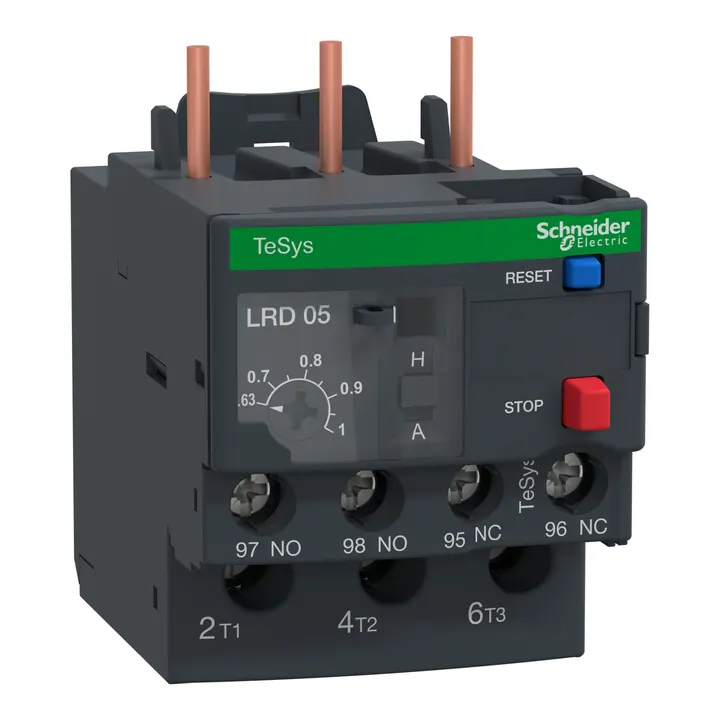
Schneider TeSys LRD Thermal Overload Relay · 0.63-1 A · LRD05
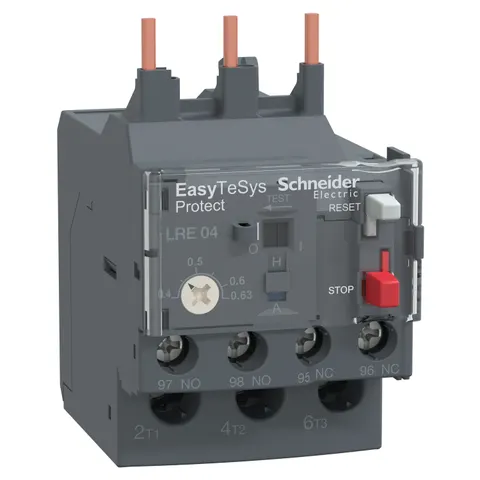
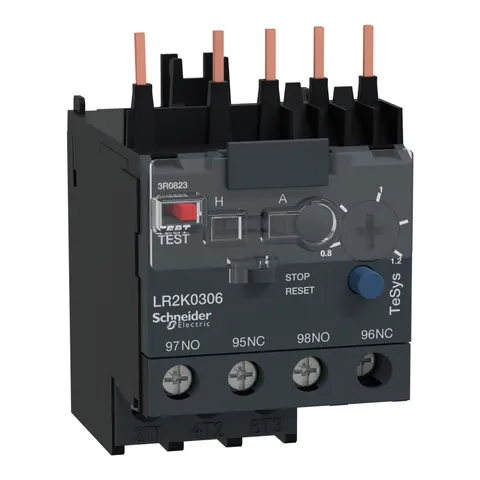
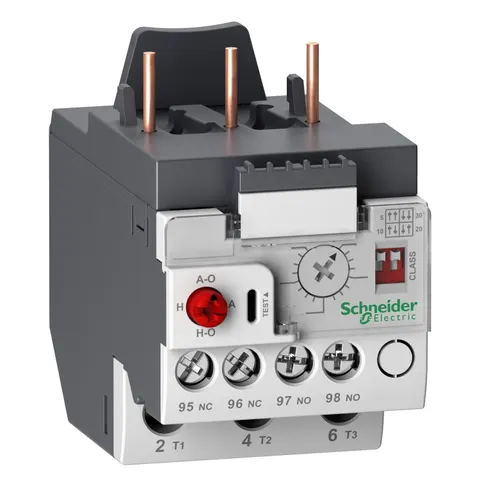
TeSys LRD thermal overload relay, 1A/690V, thermal setting range 0.63-1A, tripping class 10A, for protection of 3-phase motors 0.25-0.37kW@400V. Differential device with phase failure and load unbalance detection. It provides a thermal adjustement dial, a manual-automatic reset selector, a test selector for simulation of a tripping, reset and stop buttons, a flag indicator and 2 auxiliary contacts 1NO+1NC for fault signalling. Settings are protected by a transparent cover lockable by sealing. Connection by screw clamp terminals, it connects directly to the bottom terminals of 3-pole contactors LC1D09-D38. Mounting on DIN rail or screw fixing, separated from the contactor, with use of a terminal block LAD7B106 (to be ordered separately). Multi standards certified (IEC, UL, CSA, CCC, EAC, ATEX, Marine), Green Premium compliant (RoHs/Reach).
What should I set the overload relay to?
Set it to the motor's full-load current from the nameplate, not higher. In a star-delta starter where the relay is in the phase winding circuit, it is set to about 0.58 times the full-load current.
Will this overload relay fit my contactor?
Most overload relays are designed to mount directly on specific contactor sizes of the same brand and range. For other brands or sizes, a separate mounting kit or panel mounting is needed, so check the compatibility list.
Does it protect against single phasing?
Most modern thermal overload relays have differential (single phasing) sensitivity and trip faster when one phase is lost, which helps protect three-phase motors. For full phase failure and phase reversal protection, a phase monitoring relay is also recommended.
What is trip class 10 and class 20?
Trip class indicates the maximum time to trip from cold at 7.2 times the set current: class 10 trips within 10 seconds and class 20 within 20 seconds (IS/IEC 60947-4-1). Class 10 suits normal motors, while class 20 or 30 is used for heavy-starting loads like crushers and fans with large inertia.
What is the difference between manual and auto reset?
In manual reset, someone must press the reset button after a trip, while auto reset lets the relay reset itself once it cools. Manual reset is generally safer, since the motor will not restart unexpectedly.