
🚚 Free delivery over ₹4,000 pan-India · we also ship worldwide · Buying in bulk? Get a quote in 24 hours →
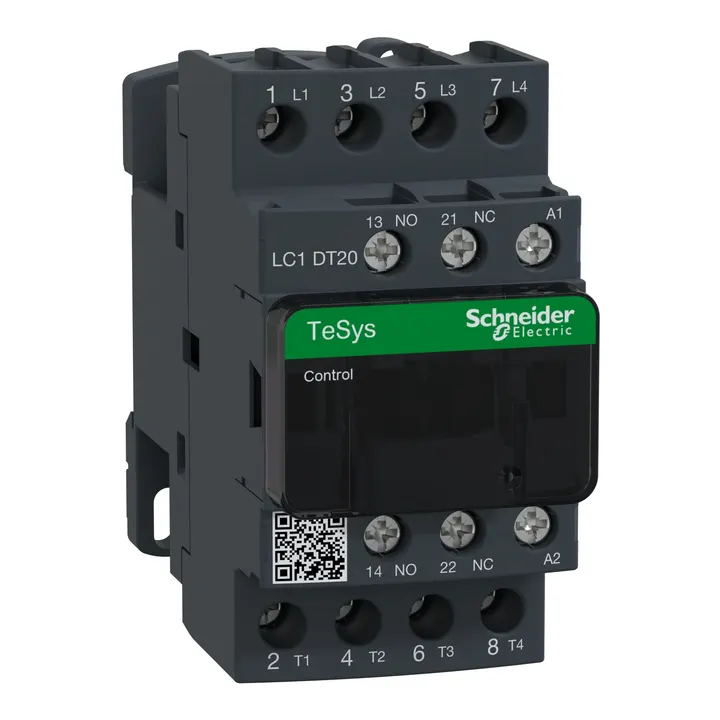
Schneider TeSys LC1D Power Contactor · 4P · 20 A AC-3 · 1 NO + 1 NC aux · 240 V AC coil · LC1DT20U7LC1DT20U7↓ 40% off1 / 8
BrandSchneider
CategoryIndustrial Control
Specification4P · 20 A AC-3 · 1 NO + 1 NC aux · 240 V AC coil
Brand SKULC1DT20U7
AvailabilityIn stock · ships in 24h
Delivery8 to 15 business days after dispatch
Schneider· In stock
Visit the Schneider store

Schneider TeSys LC1D Power Contactor · 4P · 20 A AC-3 · 1 NO + 1 NC aux · 240 V AC coil · LC1DT20U7

Rating: 20 A AC-3
Coil: 240 V AC coil
$63.62/pc-40%
$106.03
Wholesale · 15+ units
$60.43 /pc
Add to cart
Buy now
Delivery in 8 to 15 business days after dispatch
Buying in bulk? Ask our Export desk for a quote.
$63.62 /pc
Delivery in 8 to 15 business days
🏷️
100% genuine
Brand-authorised stock, sourced through authorised channels
🧾
Export invoice
Every international order ships with an export invoice for customs
🌍
Worldwide delivery
Dispatched from Ghaziabad, India · fee by weight, shown at checkout
📦
Wholesale built in
Wholesale price at 15+ units: $60.43/pc on this product, applied automatically

TeSys D contactor, 4 poles (4NO), for non-inductive load applications up to 20A/440V AC-1. They can be used to create motor starters for almost any type of application. It provides a 240V 50/60Hz AC coil, 1NO+1NC built-in auxiliary contacts (NC mirror certified), connection by screw clamp terminals. For operating rates until 3600 cycles/hour and environments until 60°C, it procures high reliability and durability. Compact (45mm width), DIN-rail mounting or screw fixing. Power contacts have a 20A resistive load rating. Multi standards certified (IEC, UL, CSA, CCC, EAC, Marine), Green Premium compliant (RoHS/REACh). Contactor has one normally open and one normally closed auxiliary contact built-in as standard. The NC contact is mirror certified. Screw clamp terminals are used for load and auxiliary connections. An extensive line of accessories makes it easy to meet the requirements of most applications. The contactor is 3.35 inches tall, 1.77 inches wide and 3.62 inches deep. It weighs 0.80 lbs. Contactor is certified to UL, CSA, IEC, CCC, EAC and Marine standards. Contactor also meets the requirements of RoHS/REACh making it a Green Premium product.
As published by Schneider. Verify critical parameters against the datasheet before specifying.
Schneider Schneider TeSys LC1D Power Contactor · 4P · 20 A AC-3 · 1 NO + 1 NC aux · 240 V AC coil · LC1DT20U7 · LC1DT20U7
Poles4P (FP)
Rated current20 A
Ingress protectionIP20 front face
Reference standardCSA C22.2 No 14
coil voltage240 V AC 50/60 Hz
Net weight0.365 kg
BrandSchneider
Brand SKULC1DT20U7
ELINE3RG394CCP
Sold asPer pc
RangeTeSys · TeSys Deca
StandardsCSA C22.2 No 14 · EN 60947-4-1 · EN 60947-5-1 · IEC 60947-4-1 · IEC 60947-5-1 · UL 60947-4-1 · IEC 60335-1
Operating time4...19 ms opening · 12...22 ms closing
Coil technologyWithout built-in suppressor module
Heat dissipation2…3 W at 50/60 Hz
Mounting supportPlate · Rail
Non-overlap time1.5 ms on de-energisation between NC and NO contact · 1.5 ms on energisation between NC and NO contact
Pollution degree3
Protective coverWith
Range of productTeSys Deca Advanced
Average impedance2.5 mOhm - Ith 20 A 50 Hz for power circuit
Device short nameLC1D
Poles description4P
Tightening torqueControl circuit: 1.7 N.m - on screw clamp terminals - with screwdriver flat Ø 6 mm · Control circuit: 1.7 N.m - on screw clamp terminals - with screwdriver Philips No 2 · Power circuit: 1.7 N.m - on screw clamp terminals - with screwdriver flat Ø 6 mm · Power circuit: 1.7 N.m - on screw clamp terminals - with screwdriver Philips No 2 · Control circuit: 1.7 N.m - on screw clamp terminals - with scr
Compatibility codeLC1D
Inrush power in VA70 VA 60 Hz cos phi 0.75 (at 20 °C) · 70 VA 50 Hz cos phi 0.75 (at 20 °C)
Control circuit typeAC at 50/60 Hz
Overvoltage categoryIII
Utilisation categoryAC-1
Contactor applicationResistive load
Insulation resistance> 10 MOhm for signalling circuit
Mechanical durability15 Mcycles
Associated fuse rating10 A gG for signalling circuit conforming to IEC 60947-5-1 · 25 A gG at <= 690 V coordination type 1 for power circuit · 20 A gG at <= 690 V coordination type 2 for power circuit
Maximum operating rate3600 cyc/h at 60 °C
Auxiliary contacts typetype mechanically linked 1 NO + 1 NC conforming to IEC 60947-5-1 · type mirror contact 1 NC conforming to IEC 60947-4-1
Connections - terminalsControl circuit: screw clamp terminals 2 1…2.5 mm² - cable stiffness: flexible with cable end · Control circuit: screw clamp terminals 1 1…4 mm² - cable stiffness: flexible without cable end · Control circuit: screw clamp terminals 2 1…4 mm² - cable stiffness: flexible without cable end · Control circuit: screw clamp terminals 1 1…4 mm² - cable stiffness: flexible with cable end · Control circuit:
Rated breaking capacity250 A at 440 V for power circuit conforming to IEC 60947
Pole contact composition4 NO
Safety reliability levelB10d = 1369863 cycles contactor with nominal load conforming to EN/ISO 13849-1 · B10d = 20000000 cycles contactor with mechanical load conforming to EN/ISO 13849-1
Minimum switching current5 mA for signalling circuit
Minimum switching voltage17 V for signalling circuit
Product or component typeContactor
Irms rated making capacity140 A AC for signalling circuit conforming to IEC 60947-5-1 · 250 A DC for signalling circuit conforming to IEC 60947-5-1 · 250 A at 440 V for power circuit conforming to IEC 60947
Power dissipation per pole1.56 W AC-1
Signalling circuit frequency25...400 Hz
[Uc] control circuit voltage240 V AC 50/60 Hz
Auxiliary contact composition1 NO + 1 NC
[Ui] rated insulation voltagePower circuit: 600 V CSA certified · Power circuit: 600 V UL certified · Signalling circuit: 690 V conforming to IEC 60947-1 · Signalling circuit: 600 V CSA certified · Signalling circuit: 600 V UL certified · Power circuit: 690 V conforming to IEC 60947-4-1
Control circuit voltage limits0.3...0.6 Uc (-40…70 °C):drop-out AC 50/60 Hz · 0.8...1.1 Uc (-40…60 °C):operational AC 50 Hz · 0.85...1.1 Uc (-40…60 °C):operational AC 60 Hz · 1...1.1 Uc (60…70 °C):operational AC 50/60 Hz
[Ie] rated operational current20 A (at <60 °C) at <= 440 V AC AC-1 for power circuit
[Ue] rated operational voltagePower circuit: <= 690 V AC 25...400 Hz · Power circuit: <= 300 V DC
Hold-in power consumption in VA7.5 VA 60 Hz cos phi 0.3 (at 20 °C) · 7 VA 50 Hz cos phi 0.3 (at 20 °C)
[Uimp] rated impulse withstand voltage6 kV conforming to IEC 60947
[Icw] rated short-time withstand current30 A 40 °C - 10 min for power circuit · 61 A 40 °C - 1 min for power circuit · 105 A 40 °C - 10 s for power circuit · 210 A 40 °C - 1 s for power circuit · 100 A - 1 s for signalling circuit · 120 A - 500 ms for signalling circuit · 140 A - 100 ms for signalling circuit
[Ith] conventional free air thermal current10 A (at 60 °C) for signalling circuit · 20 A (at 60 °C) for power circuit
Ratings as published by Schneider (se.com). Verify critical parameters against the datasheet before specifying.
How do I choose a contactor for my motor?

Select by the contactor's AC-3 current (or kW) rating at your supply voltage, which should be at least the motor's full-load current from the nameplate. Do not go by the higher AC-1 rating, which applies only to resistive loads (contactors are covered by IS/IEC 60947-4-1).

What is the difference between AC-1 and AC-3 rating?

AC-1 is for non-inductive or slightly inductive loads like heaters, while AC-3 is for starting and stopping squirrel cage motors. The same contactor has a much lower AC-3 rating than AC-1, and AC-4 (inching or plugging) is even more demanding.

Does a contactor protect the motor?

No. A contactor only switches the motor on and off; overload protection needs a thermal overload relay and short-circuit protection needs an MPCB, MCB, MCCB or fuses upstream.

Why is my contactor humming or chattering?

Common causes are low or fluctuating control voltage, a wrong coil voltage, dust or rust on the magnet faces, or a broken shading ring. Check the supply at the coil terminals first, then clean or replace the contactor if needed.

How many auxiliary contacts does this have and can I add more?

Most contactors have built-in auxiliary contacts (NO and/or NC) for holding and interlocking circuits, and many allow add-on auxiliary blocks on the front or side. Check the contact configuration and add-on compatibility in the product details.

How many contactors do I need for a star-delta starter?

A star-delta starter uses three contactors (main, delta and star), a star-delta timer and an overload relay. The main and delta contactors are typically sized at about 58% of the motor current and the star contactor smaller, as per the manufacturer's selection table.

No reviews yet