

Why Do You Need an Auxiliary Contact in a Contactor?
- Main contacts carry the motor current. Auxiliary contacts carry small control signals that report the contactor's state to the control circuit.
- Four standard uses: the holding (seal-in) contact for push-button start-stop, electrical interlocks in reversing and star-delta starters, feedback to a PLC, and indication lamps.
- A NO (normally open, terminals ending 3-4) contact closes when the coil is energised. An NC (normally closed, terminals ending 1-2) contact opens.
- Count auxiliaries per feeder before ordering. A DOL starter with PLC feedback commonly needs 1 NO for holding, 1 NO for feedback and 1 NC for an 'off' lamp.
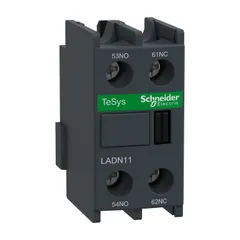
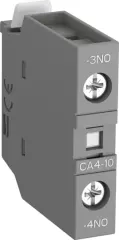
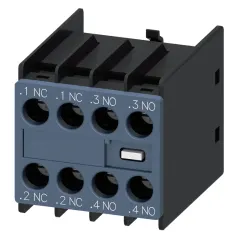
- Add-on blocks clip onto the front or side: ABB CA4 and CAL, Schneider LADN, Siemens 3RH2911. They are among the cheapest parts in the panel and among the most often forgotten.
A contactor's three big main contacts get all the attention because they switch the motor. Most of the logic in a motor control panel, though, runs through the small auxiliary contacts beside them. Without them, a start push button would only run the motor while someone held it pressed, a reversing starter could short two phases, and the PLC would have no idea whether the motor had actually started.
This guide explains what auxiliary contacts do, the four jobs they cover in almost every panel, and how to count and order them so a feeder is not left one contact short at testing.
Main contacts vs auxiliary contacts
When the coil is energised, the armature moves and closes the main power contacts. It also moves a set of small auxiliary contacts rated for control currents, typically a few amps at 230 V AC (category AC-15) or 24 V DC (DC-13). A normally open (NO) auxiliary closes when the contactor pulls in, and a normally closed (NC) one opens. Because they move with the main contacts, they report the contactor's real state, which is the whole point. On a terminal diagram, NO auxiliaries are numbered with x3-x4 (13-14, 43-44) and NC with x1-x2 (21-22, 31-32).
Job 1: the holding (seal-in) contact
In a standard start-stop circuit, the START push button is momentary. A NO auxiliary contact is wired in parallel with it, so when the contactor pulls in, that contact closes and keeps the coil energised after the button is released. Pressing STOP (an NC button in series) breaks the circuit, the contactor drops out, and the holding contact opens, so the motor will not restart on its own when power returns after an outage. That is an important safety property. If a contactor's built-in auxiliary is already used for something else, a front-mount block such as the Schneider LADN11 (1 NO + 1 NC) adds two more.
Job 2: electrical interlocks in reversing and star-delta starters
A reversing starter has two contactors that swap two phases. If both close together, it is a phase-to-phase short circuit. The standard protection is an NC auxiliary of each contactor wired in series with the other contactor's coil, so neither can pull in while the other is closed. A mechanical interlock is usually added as a second barrier. Star-delta starters use the same principle between the star and delta contactors. ABB's CA4-10 is a 1 NO front-mount block for AF and AX contactors, and the CA4-01 is the 1 NC version for interlocks.
Job 3: feedback to the PLC or SCADA
When a PLC commands a motor to start, it needs to know that the contactor actually closed, not only that the output was switched on. A NO auxiliary wired to a PLC input gives that 'running' feedback, and the program raises a fault if the command and feedback disagree for more than a second or two. For safety-related circuits, standards call for 'mirror contacts' (IEC 60947-4-1 Annex F): NC auxiliaries guaranteed never to be closed while any main contact is welded shut. Check the datasheet if your design relies on this. Siemens' 3RH2911-1HA11 adds 1 NO + 1 NC to SIRIUS 3RT2 S00 contactors.
Job 4: indication lamps and alarms
The ON, OFF and TRIP lamps on a panel door are usually driven through auxiliaries: a NO for the 'running' lamp and an NC for the 'stopped' lamp. The trip lamp is driven by the overload relay's own auxiliary (the 97-98 NO contact), not the contactor's. Indication is the first thing cut when auxiliaries run short, and the first thing a client notices at the factory acceptance test.
Buying tips
- Count auxiliaries per feeder from the control drawing before ordering: holding, interlocks, PLC feedback, indication. Then subtract the contactor's built-in auxiliaries.
- Buy blocks in the contactor's own family. LADN fits TeSys D, CA4 fits ABB AF/AX, and 3RH2911 fits SIRIUS 3RT2 S00. They are not interchangeable.
- Check the maximum number of add-on blocks a contactor accepts (front plus side). Large auxiliary requirements may need a separate contactor relay.
- For 24 V DC PLC inputs, check that the auxiliary is rated for low-level switching. Some blocks have specific low-current versions.
- Order 10% spare auxiliary blocks for any panel with more than a few feeders. Late drawing changes almost always add contacts.
Frequently asked questions
What is the function of an auxiliary contact in a contactor?
It switches control signals in step with the main contacts. That lets the control circuit hold the contactor in (seal-in), interlock it against another contactor, report its state to a PLC, and drive indication lamps.
What is the difference between NO and NC auxiliary contacts?
A normally open (NO) contact is open when the coil is de-energised and closes when the contactor operates. A normally closed (NC) contact is closed at rest and opens when the contactor operates.
Can a contactor work without an auxiliary contact?
The main contacts will switch the load, but you cannot build a push-button start-stop, an interlock or PLC feedback without at least one auxiliary. Some contactors have one built in; others need an add-on block.
What do 13-14 and 21-22 mean on a contactor?
They are auxiliary contact terminal numbers. Numbers ending 3-4 are normally open, and numbers ending 1-2 are normally closed. The first digit is the contact's position number.
Are auxiliary contact blocks universal?
No. Each contactor family has its own blocks. Order them by the contactor's range, such as LADN for Schneider TeSys D, CA4 or CAL for ABB AF/AX, and 3RH2911 for Siemens 3RT2.
Compare MRP vs the Elume price across brands, with wholesale prices on 15+ units.
Browse the catalogue →