

What Is a Contactor? Uses, Types and How to Pick One (India Guide)
- A contactor is an electrically operated switch: a small control signal switches a big load on and off, thousands of times, without anyone touching the circuit.
- It does not protect anything; pair it with an MCB or MCCB for fault protection.
- Homes meet contactors in pump automation, timers and three-phase changeovers; industry runs on them.
- Buy by three numbers: load current (AC-1/AC-3 rating), coil voltage (usually 230 V AC in India), and pole count.
Every time a water pump starts on a float switch, a street light turns on at dusk, or a machine starts from a push button, a contactor is doing the work. It is the device that lets a small, safe control signal (a timer, a sensor, a button) switch a large electrical load, and do it tens of thousands of times without wearing out a wall switch or a human finger.
This guide explains what a contactor actually is, how it differs from the relay and the MCB it is often confused with, where homes genuinely use them, and how to read the ratings on a contactor listing so you order the right one the first time.
The basics: an electromagnet that closes a switch
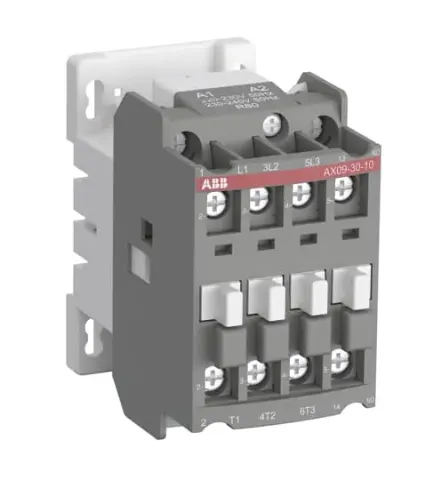
Inside a contactor is a coil and a set of spring-loaded contacts. Energise the coil (say, with 230 V from a timer) and the electromagnet pulls the contacts closed, connecting the load; cut the coil supply and the spring snaps them open. That is the whole trick: the control circuit and the load circuit never touch, so a delicate timer output can safely start a 3 HP pump. The ABB AX09 here is the classic entry point: a 9 A three-pole contactor with a 230 V coil, the size that runs small pumps and heaters.
Contactor vs relay vs MCB: three different jobs
A relay is the same idea at signal scale: it switches milliamps to a few amps, for logic and indication. A contactor is a relay grown up: built to make and break real load currents, with arc chutes to survive the spark each break creates. An MCB is neither: it is a protection device that opens on a fault and is operated by hand. The classic panel uses all three: relays for logic, a contactor to switch the load, and an MCB or MCCB upstream to protect the cable. The NX22E here is a contactor RELAY: use it for control logic, not for switching loads.
Where a home actually meets contactors
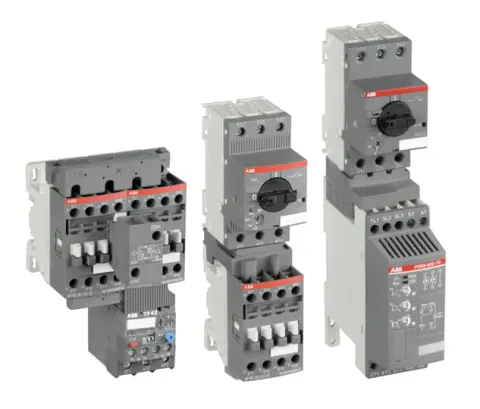
Three places, mainly. Pump automation: a float switch or timer energises a contactor that runs the bore or sump pump, so the tiny switch never carries pump current. Timer-driven loads: gate lights, garden lights and society common lighting on a time switch. And three-phase homes: changeover and load-management schemes use contactors to shed or switch loads. If your electrician says 'we will put it on a contactor', this is what they mean, and the AX12 (12 A) covers most of these domestic jobs with margin.
Reading the ratings: AC-1, AC-3 and coil voltage
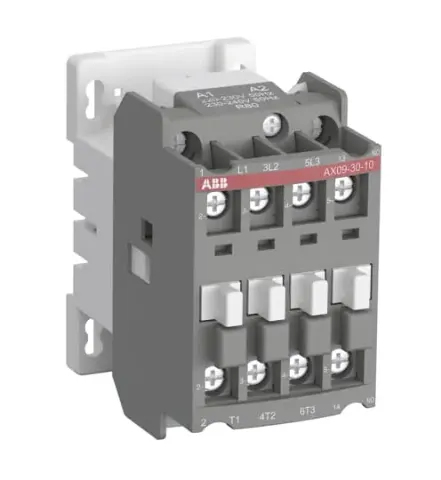
Two current ratings appear on every contactor and they differ on purpose. AC-1 is the easy rating: resistive loads like heaters. AC-3 is the honest rating for motors, which draw a starting surge of six to eight times running current; a contactor rated 25 A AC-1 might be only 9 A AC-3. Always size motors by the AC-3 figure. The coil voltage must match your control supply: in India that is usually 230 V AC, but panels running on control transformers use 110 V (like this AX09 variant) or 24 V. Order the wrong coil and the contactor simply never pulls in.
Reversing and interlocks: two contactors, one motor
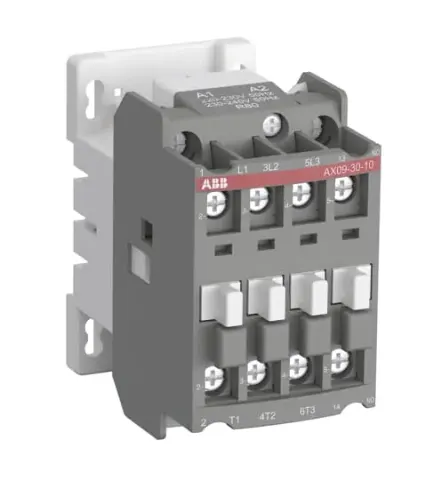
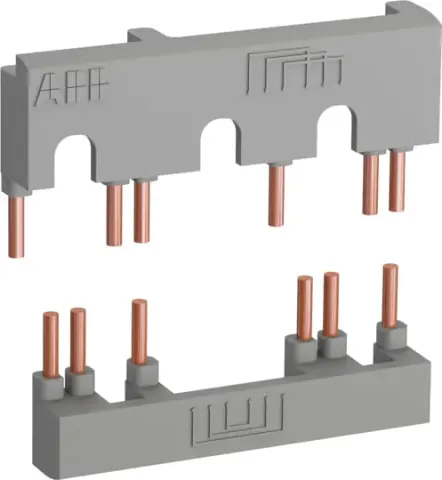
Run a motor forwards and backwards (a gate, a hoist, some pumps) and you need two contactors wired to swap two phases, plus an interlock so both can never close together, which would be a dead short. Manufacturers sell the interlock and busbar links as a kit: this ABB BER16-4 connection set turns a pair of AX contactors into a ready reversing starter without loose wiring between them.
Buying tips
- Size motors by the AC-3 rating, never AC-1. A 1 HP single-phase pump draws about 7-8 A running: a 9 A AC-3 contactor (AX09 class) fits, but the next size up costs little and lasts longer against starting surges.
- Match the coil voltage to the control circuit exactly: 230 V AC for direct-from-mains control in Indian homes, 110 V or 24 V only when a control transformer or PLC supplies the coil.
- A contactor protects nothing. Put an MCB (or MCCB for big feeds) upstream sized to the cable, and for motors add an overload relay matched to the motor's running current.
- Auxiliary contacts (the -10, -01 suffixes on ABB part numbers: one normally-open or one normally-closed) are how the circuit signals its own state: indicator lamps, holding circuits, interlocks. Count what your scheme needs before ordering.
- For pump duty on borewells, pair the contactor with a dry-run preventer; the contactor switches, the preventer decides when not to.
Frequently asked questions
Do I need a contactor for my house?
For ordinary wiring, no. You need one the moment a load is switched automatically (timer, float switch, sensor) or is too large for a wall switch to handle honestly: pumps are the classic case. Your electrician wires it inside the DB or a small enclosure; you never operate it directly.
What is the difference between a contactor and a starter?
A starter is a contactor plus protection: typically the contactor, an overload relay, and sometimes short-circuit protection in one assembly. Buy a starter (or assemble the pair) for motors; a bare contactor alone leaves the motor unprotected against overload.
Why does my contactor hum or chatter?
A healthy contactor makes one clean click. Humming usually means dust or a weak control supply preventing the magnet from seating fully; chattering (rapid on-off) means the coil voltage is sagging, often from a too-thin control wire or a failing float switch. Both wear contacts fast and want fixing, not ignoring.
Single-phase pump: 2-pole or 3-pole contactor?
Either works; a 3-pole like the AX09 is the stocked standard, and for single-phase you simply use two of the three poles. Wiring all three poles in series on one line is an old trick to extend contact life on hard-switching duties.
How long does a contactor last?
Mechanically, millions of operations; electrically, it depends on the load switched. Motor duty at AC-3 ratings is typically good for hundreds of thousands of operations. In a home pump scheme switching a few times a day, a quality contactor outlives the pump.
Compare MRP vs the Elume price across brands, with an extra 5% wholesale rate on 15+ units.
Browse the catalogue →