

Surge Protection for Rooftop Solar: AC vs DC SPD, Type 1 vs Type 2, and Which Brand to Choose
- A rooftop system usually needs two SPDs: a PV-rated DC SPD in the DCDB and an AC SPD in the ACDB. They are different devices and not interchangeable.
- DC SPD: choose Ucpv at or above the array's cold-weather maximum Voc, and check the product is tested to the PV standard (IEC 61643-31 or its older equivalent).
- AC SPD: Type 2, 1P+N for single-phase inverters and 3P+N for three-phase, with Uc around 275-320 V.
- Type 2 suits most homes. Use Type 1+2 where the building has a lightning protection system (air terminal or lightning arrester) or a long exposed overhead feed.
- An SPD only works with short, solid earth connections. Its earth lead length matters as much as its kA rating.
Lightning and switching surges are a big reason inverters fail early, and the monsoon in most of India makes rooftop arrays an attractive target: a large metal structure on the highest point of the building. Surge protection devices are cheap compared with an inverter replacement and a service visit, which is why almost every DISCOM and PM Surya Ghar specification includes them in the DCDB and ACDB.
SPDs are also the component installers most often get subtly wrong: an AC SPD in a DC box, a DC SPD rated below the array voltage, a correctly rated SPD wired with a two-metre earth lead. This guide covers where each type goes, how to read the ratings, and how the brands we stock compare.
Two sides, two different SPDs
The DC side, from modules to inverter input, carries a steady DC voltage of up to several hundred volts with no current zero. The AC side carries 230 V or 415 V mains. An AC SPD's varistors and disconnector are designed for AC. On a PV array they can fail to disconnect safely at end of life and become a fire risk. DC SPDs for PV use designs and internal disconnectors tested for PV DC (IEC 61643-31; older products cite EN 50539-11). The rule: a PV-rated SPD in the DCDB, close to the inverter's DC input, and an AC SPD in the ACDB at the inverter output or the point of connection.
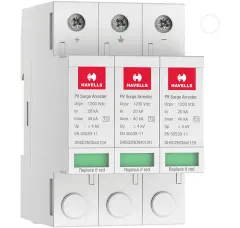
DC SPD for 3-10 kW rooftops: Havells PV Type 2
For a typical residential string, this Havells photovoltaic SPD is the practical choice: Ucpv 1200 V DC, Imax 40 kA, In 20 kA, in a DIN-rail format that fits a standard DCDB. Its 1200 V Ucpv covers any residential string, and leaves margin even for 1000 V systems. Check the protection level (Up, 4 kV here) against the inverter's DC input impulse withstand, which is usually well above that for modern string inverters.
DC Type 1+2 for exposed or protected buildings: L&K AU Solar
If the building has an external lightning protection system (an air terminal or ESE lightning arrester) and the array cannot keep the required separation distance from it, part of a direct strike current can enter the DC cabling. A Type 1+2 SPD rated for impulse current (Iimp) is then the right class. L&K's AU Solar DC SPD is a Type 1+2 unit with Iimp 12.5 kA and Imax 50 kA, in Ucpv 880 V and 1360 V versions. Pick the version above your cold-weather Voc. It costs much more than a Type 2 unit, so use it where the risk assessment calls for it, typically on commercial roofs, rural sites with tall structures, and buildings with an LPS.
AC SPD for the ACDB: Havells Type 2, 1P+N or 3P+N
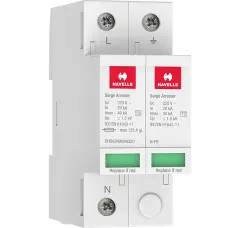
On the AC side, a Type 2 SPD in the ACDB protects the inverter's output stage and the home's own wiring. For single-phase inverters (most 3 kW and 5 kW systems) use 1P+N, as in this Havells Type 2 unit: Uc 320 V, Imax 40 kA, In 20 kA, with an Up of 1.5 kV. For three-phase 10 kW systems use the 3P+N version. This Havells Type 2 unit is the most-bought surge protection product on Elume.
Where to spend more: Type 1+2 AC at the main incomer
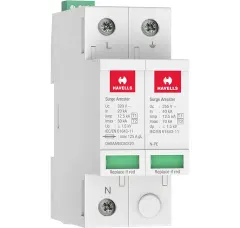
Homes fed by long rural overhead lines, or buildings with lightning arresters on the roof, benefit from a Type 1+2 AC SPD at the main incomer, with a Type 2 at the ACDB downstream if the cable run between them is long. Havells' Type 1+2 1P+N (Iimp 12.5 kA, Imax 50 kA) is an upgrade you can offer as an add-on line in the quotation. Explain it to the customer as protection for the whole house, not only the solar system. That framing often wins the sale.
The installation detail that decides whether any SPD works
During a surge, the SPD and its connecting leads form one path to earth. Every metre of lead adds roughly 1 kV of inductive voltage at surge current rates, on top of the SPD's own protection level. Keep the total of live and earth leads under about 0.5 m (the familiar '50 cm rule'), run them straight, and connect to a proper earth bar bonded to the system's earth electrode. A 40 kA SPD wired with two metres of looping earth wire protects far less than the label suggests. Check the status windows during every service visit, because SPDs sacrifice themselves and need replacing after heavy strikes.
Buying tips
- Never use an AC SPD in a DCDB. Check for 'PV' or 'DC' and a Ucpv rating on the label.
- Set Ucpv at or above the cold-weather maximum Voc of the array, the same number you use for the DC MCB and isolator.
- Choose Type 1+2 on the DC side only where there is a lightning protection system or a high-exposure site. Otherwise Type 2 is the right class and price.
- Keep SPD leads short and straight (under about 0.5 m in total) and bonded to the same earth system.
- Stock replacement cartridges where the model uses them, and check status windows after the monsoon.
Frequently asked questions
Do I need both AC and DC SPDs in a rooftop solar system?
In almost all cases, yes. The DC SPD protects the inverter's DC input and the array wiring, and the AC SPD protects the inverter output and the building wiring. Most DISCOM and PM Surya Ghar specifications require both.
What is Ucpv on a solar SPD?
The maximum continuous PV DC voltage the SPD can be connected to. It must be at or above the array's maximum open-circuit voltage at the lowest expected temperature.
Type 1 or Type 2 SPD for rooftop solar?
Type 2 for most rooftops. Type 1+2 where the building has an external lightning protection system that the array cannot be separated from, or on high-exposure sites.
Can I use an AC SPD on the DC side?
No. AC SPDs are not designed or tested to disconnect safely on PV DC and can overheat at end of life. Use an SPD tested to the PV standard (IEC 61643-31).
Does Elume sell solar SPDs in bulk?
Yes. Havells, L&K and Legrand AC and PV SPDs are listed with GST invoices, and the wholesale price applies automatically from 15 units of the same item. For larger or mixed orders, send a bulk enquiry.
Compare MRP vs the Elume price across brands, with wholesale prices on 15+ units.
Browse the catalogue →