

mm² to AWG Wire Size Chart: Converting Cable Sizes for International Projects (2026)
- Metric cables are sized by conductor cross-section in mm² (IEC 60228); AWG is a gauge number where a smaller number means a thicker wire.
- The two systems never line up exactly, so a metric cable is always chosen at or above the AWG area it replaces, never below.
- Everyday swaps: 14 AWG becomes 2.5 mm², 12 AWG becomes 4 mm², 10 AWG becomes 6 mm², 8 AWG becomes 10 mm².
- After converting, check the cable against the local wiring rules for current rating, grouping and voltage drop.
Drawings and specifications travel further than cables do. A consultant in one country writes 12 AWG, the panel builder in another buys metric stock, and the contractor on site has to make the two agree. Most metric markets stock conductors in the IEC 60228 sizes: 1, 1.5, 2.5, 4, 6, 10, 16 mm² and up. North American drawings, and many specifications written from them, use AWG (American Wire Gauge).
This chart gives the AWG equivalent of every common metric size, the area of that gauge, and the metric size to buy when the drawing gives you AWG. The rule underneath it all is simple: when the sizes do not match, go up a size, then confirm the cable against the wiring rules that apply where it will be installed.
How the two systems differ
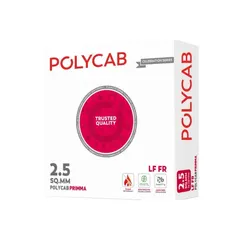
A metric size is the conductor's cross-sectional area: a 1.5 mm² wire has 1.5 square millimetres of copper. AWG runs the other way: each step up the number is a thinner wire, and every six gauges roughly halves the area. 16 AWG is 1.31 mm², 14 AWG is 2.08 mm², 12 AWG is 3.31 mm². Because the steps are different, a metric size almost always sits between two gauges. 1.5 mm² falls between 16 AWG (1.31 mm²) and 15 AWG (1.65 mm²) and is usually treated as the 16 AWG equivalent in lighting circuits. The Polycab Primma 1.5 mm² here is the typical lighting-circuit conductor in metric installations.
2.5 mm² for 14 AWG, the everyday socket circuit
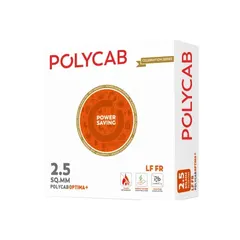
14 AWG is 2.08 mm². The nearest metric sizes are 1.5 mm² (too small) and 2.5 mm² (larger), so a drawing that calls for 14 AWG is built in 2.5 mm². It is the standard size for socket and small-appliance circuits in most metric markets, which makes it the most common single line in any building BOQ. The Polycab Optima+ 2.5 mm² single-core house wire here is a typical example of that size.
4 mm² for 12 AWG, and 6 mm² for 10 AWG
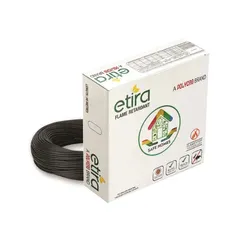
12 AWG (3.31 mm²) sits between 2.5 and 4 mm², so it becomes 4 mm²: heavier socket circuits, water heaters and longer runs where voltage drop starts to matter. 10 AWG (5.26 mm²) sits between 4 and 6 mm², so it becomes 6 mm²: cookers, air-conditioner circuits and small sub-mains. Rounding down here is the one mistake that cannot be fixed later without rewiring, because the protective device was chosen for the larger conductor. The Polycab Etira 4.0 mm² here is the size you would substitute for a 12 AWG line.
10 mm² and above: sub-mains and feeders
At the larger end the gauges get coarser. 8 AWG (8.37 mm²) becomes 10 mm², 6 AWG (13.3 mm²) becomes 16 mm², 4 AWG (21.2 mm²) becomes 25 mm², 2 AWG (33.6 mm²) becomes 35 mm², and 1 AWG (42.4 mm²) becomes 50 mm². From 1/0 AWG upwards sizes are written as 1/0, 2/0, 3/0, 4/0 and then in kcmil (thousands of circular mils): 2/0 (67.4 mm²) is replaced by 70 mm², 3/0 (85 mm²) by 95 mm², 4/0 (107 mm²) by 120 mm². These sizes are usually multi-core armoured cable on drums rather than single-core coils, and the installation method changes the rating more than the conversion does. The RR Kabel Q1 6.0 mm² here marks the top of the single-core house-wire range.
Reading the label once the size is right
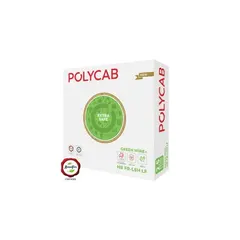
Size is only the first field. A cable label also tells you the conductor (copper, solid or stranded and flexible), the insulation and sheath (PVC, flame retardant, low smoke, halogen free) and the voltage grade (450/750 V for building wire, 0.6/1 kV for power cable). Specifications written for public buildings, tunnels and high-rise towers often call for low-smoke or halogen-free insulation, so convert that requirement along with the size. The Polycab Green Wire+ here carries an HR FR-LSH grade: heat resistant, flame retardant, low smoke.
Buying tips
- When a drawing gives AWG, buy the next metric size at or above its area: 14 AWG = 2.5 mm², 12 AWG = 4 mm², 10 AWG = 6 mm², 8 AWG = 10 mm², 6 AWG = 16 mm².
- Convert the protective device with the cable: a breaker sized for a 12 AWG circuit in one market may not suit 4 mm² under another country's rules, so check both together.
- Keep the insulation requirement when converting: low smoke, halogen free or a fire-survival rating in the specification does not change with the size system.
- On long runs, voltage drop often decides the size, not current rating; converting the size exactly is not enough if the original design was already close to the limit.
- Write both sizes on the BOQ (for example "4 mm² (replaces 12 AWG)") so the site, the supplier and the inspector all read the same line.
Frequently asked questions
What is 2.5 mm² in AWG?
2.5 mm² sits between 14 AWG (2.08 mm²) and 13 AWG (2.63 mm²). It is treated as the metric replacement for 14 AWG, and 13 AWG is rarely stocked.
What size is 12 AWG in mm²?
12 AWG is 3.31 mm². In metric stock you buy 4 mm², the next size up; 2.5 mm² is smaller than 12 AWG and should not be used in its place.
Is 1.5 mm² the same as 16 AWG?
Close but not the same: 16 AWG is 1.31 mm², so 1.5 mm² is slightly larger. It is the usual metric size for lighting circuits where a North American drawing would show 14 or 16 AWG depending on the protective device.
Why do you always round up when converting?
Because the protective device, the voltage drop and the heating of the cable were all calculated for the original conductor area. A larger conductor keeps every one of those within limits; a smaller one can overheat or trip the design out of compliance.
Can Elume supply metric cables for an AWG-specified project?
Yes. Send the BOQ as written, AWG sizes and all, through the export desk; we match each line to the metric size, insulation and voltage grade and quote it in one consolidated quote within 24 hours.
Compare MRP vs the Elume price across brands, with wholesale prices on 15+ units.
Browse the catalogue →