

What Is the Difference Between an MCB, MCCB and ACB?
- MCB: up to 125 A, fixed trip curve (B, C, D), typically 6-10 kA. Used for final circuits and control circuits.
- MCCB: roughly 16 A to 1,600 A in common frames, breaking capacities from about 10 kA to over 100 kA, fixed or adjustable trips. Used for feeders and smaller incomers.
- ACB: roughly 630 A to 6,300 A, high short-time withstand (Icw) for selectivity, draw-out and maintainable. Used for main incomers and bus couplers.
- Choose by current, then breaking capacity from the fault level, then whether you need adjustable protection and selectivity.
- A typical LT panel uses all three: an ACB incomer, MCCB outgoing feeders, and MCBs for lighting and control circuits.
All three devices do the same basic job: they carry current normally and open automatically on overload or short-circuit. They differ in how much current they carry, how big a fault they can safely interrupt, how finely you can set them, and how they are maintained. Those differences decide where each one sits in a panel.
This guide sets the three side by side in practical terms for Indian LT panels at 415 V, with the numbers that drive the choice and the mistakes that cost money.
MCB: final circuits and control circuits up to 125 A
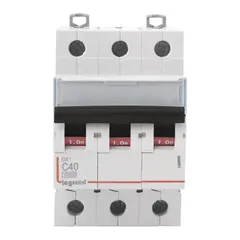
A miniature circuit breaker is a compact, DIN-rail device built to IS/IEC 60898-1, rated up to 125 A, with a fixed thermal-magnetic trip. You choose its behaviour through the trip curve: B for resistive loads, C for general and lightly inductive loads, D for high-inrush loads such as transformers and small motors. Rated short-circuit capacity (Icn) is typically 6 kA or 10 kA. In an industrial panel, MCBs protect lighting, sockets, control transformers and control circuits. This Legrand DX3 32 A three-pole C-curve MCB is a typical control or small-feeder breaker.
MCCB: feeders from about 16 A to 1,600 A
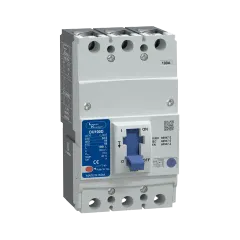
A moulded case circuit breaker, built to IEC 60947-2, covers the middle ground. Common frames run from about 16 A to 1,600 A, with breaking capacities from around 10 kA up to 100 kA or more. Two ratings matter: Icu, the ultimate breaking capacity, and Ics, the service breaking capacity after which the breaker must still be usable. Entry MCCBs have fixed thermal-magnetic trips. Better ones have adjustable thermal settings, and electronic releases add adjustable long-time, short-time and instantaneous (LSI) settings. This L&K DU100D (100 A, 18 kA) is a typical outgoing-feeder MCCB. Many MCCBs take accessories: auxiliary and alarm contacts, shunt and undervoltage releases, rotary handles and motor operators.
ACB: main incomers from about 630 A to 6,300 A
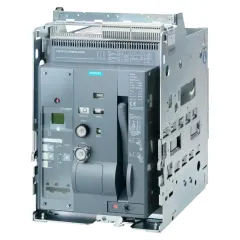
An air circuit breaker interrupts the arc in air, in arc chutes, and is built for the largest LT currents, from roughly 630 A to 6,300 A. Its defining feature is a high short-time withstand current (Icw). An ACB can deliberately hold a fault for a set delay so that a downstream MCCB clears it first. This is called selectivity (or discrimination), and it means a fault on one feeder does not black out the whole plant. ACBs come in fixed and draw-out versions, with manual or motorised operation, and their contacts can be inspected and maintained. That is why they are standard as transformer incomers and bus couplers. This Siemens 3WT 630 A, 66 kA manual fixed ACB is an example.
How to choose: current, then fault level, then selectivity
Work in this order. First, the rated current of the circuit. Below 63 A an MCB is normal, from 100 A to 630 A an MCCB, and above 800 A an ACB, with overlap in between. Second, the prospective short-circuit current at that point in the system: the device's breaking capacity must exceed it, and this alone often moves a 63 A circuit from an MCB to a small MCCB near a large transformer. Third, whether you need adjustable protection and selectivity. If the client wants upstream breakers to stay closed for downstream faults, you need electronic releases and a selectivity study using the maker's tables. That usually means an ACB, or a high-end MCCB, at the top.
Common mistakes that cost money
Three mistakes come up again and again. The first is buying on Icu alone: a cheap MCCB with Ics at 50% of Icu may not be reusable after a fault that a 100% Ics unit would survive. The second is fitting an ACB where a 630 A MCCB would do. Below about 800 A, a good MCCB with an electronic release is usually cheaper and smaller, unless the specification asks for a draw-out ACB. The third is forgetting accessories. An MCCB or ACB without the auxiliary contacts, shunt trip or interlock in the specification is not finished, and these are separate part numbers with their own lead times.
Buying tips
- Get the fault level at each board from the consultant or calculate it from transformer kVA and impedance. Every breaking capacity choice depends on it.
- Compare MCCBs on Ics as well as Icu, and on whether the thermal setting is adjustable.
- For incomers above 630 A, check whether the specification needs draw-out and motorised operation. Both change price and lead time a lot.
- Order ACB and large MCCB accessories (aux contacts, shunt trip, UV release, interlocks) in the same order as the breaker.
- Keep breaker brands consistent down a feeder chain if you need selectivity. Selectivity tables are published brand by brand.
Frequently asked questions
What is the main difference between MCB, MCCB and ACB?
Current range and breaking capacity. MCBs go up to 125 A with fixed trips and typically 6-10 kA capacity. MCCBs cover roughly 16-1,600 A with 10-100+ kA and often adjustable trips. ACBs cover roughly 630-6,300 A with high short-time withstand for selectivity, and draw-out, maintainable designs.
Can I use an MCCB instead of an ACB?
Up to about 1,600 A, often yes, and below about 800 A it is usually the cheaper choice. Choose an ACB where you need high short-time withstand for selectivity, draw-out maintenance, or the specification requires one.
What is the difference between Icu and Ics?
Icu is the highest fault current the breaker can interrupt. Ics is the fault current it can interrupt and still remain fit for service, expressed as a percentage of Icu (25, 50, 75 or 100%). Critical feeders should have a high Ics.
Which standard applies to MCBs and MCCBs in India?
Domestic and similar MCBs are built to IS/IEC 60898-1. MCCBs and ACBs are built to IS/IEC 60947-2, which also covers industrial MCBs used in panels.
Does Elume stock MCCBs and ACBs?
Yes. MCCBs from L&K, Legrand, Siemens, Schneider and ABB, ACBs from Siemens and others, and the matching accessories, all with GST invoices. For incomers with specific configurations, send the specification as a bulk enquiry for a quote and lead time.
Compare MRP vs the Elume price across brands, with wholesale prices on 15+ units.
Browse the catalogue →