

MCB Trip Curves B, C and D and Breaking Capacity: Choosing Breakers for Projects (2026)
- The trip curve sets how much inrush current an MCB tolerates: B trips at 3 to 5 times its rating, C at 5 to 10 times, D at 10 to 20 times.
- Breaking capacity (6 kA, 10 kA and up) must be at least the prospective short-circuit current where the breaker is installed.
- IEC 60898-1 rates breakers for household and similar use (Icn); IEC 60947-2 rates them for industrial use (Icu and Ics). Many MCBs carry both.
- Pick the curve for the load, the rating for the cable, the breaking capacity for the supply, and the poles for the system.
Every MCB on a BOQ is really four decisions written as one line: the current rating, the trip curve, the breaking capacity and the number of poles. Get the rating wrong and the cable is unprotected; get the curve wrong and motors or LED drivers trip the breaker every morning; get the breaking capacity wrong and the breaker may not survive the fault it is there to clear.
This guide walks through each decision the way a panel builder or contractor makes it, with the standards that the markings on the breaker refer to, so a specification written in one country can be supplied from stock built to the same IEC standards anywhere.
B curve: resistive loads and long cable runs
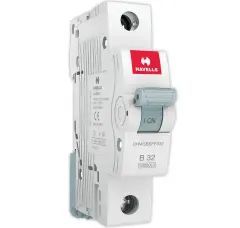
A B-curve MCB trips magnetically between 3 and 5 times its rated current. That low threshold makes it the right choice where inrush is small and fault currents may be limited by long cable runs, which is why B-curve breakers are common on domestic lighting and socket circuits in many countries, including most UK homes. The trade-off is nuisance tripping on loads with a high switch-on surge. The Havells 32 A single-pole B-curve MCB here is a typical final-circuit breaker for socket circuits.
C curve: the general-purpose default
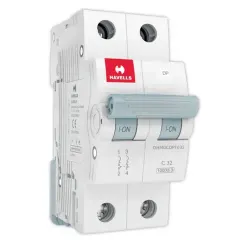
A C-curve MCB trips between 5 and 10 times its rating. It rides through the inrush of fluorescent and LED lighting drivers, small motors, compressors and IT equipment, which is why it is the general-purpose choice for commercial buildings and most panels. If a specification simply says MCB without a curve, C is usually what is meant, but confirm it. The Havells 32 A double-pole C-curve MCB here is the kind of breaker that protects a two-wire commercial circuit.
D curve: transformers, motors and high inrush
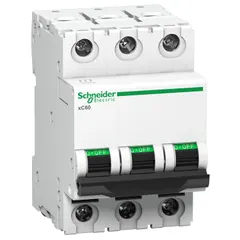
A D-curve MCB tolerates 10 to 20 times its rating before tripping magnetically. It is chosen for loads with a heavy switch-on surge: transformers, X-ray and welding equipment, and motors started direct on line. Because it needs a large fault current to trip quickly, the circuit must be designed so that a fault at the far end still produces enough current; that is a design check, not a buying one. The Schneider Acti9 xC60 63 A three-pole D-curve MCB here is a typical choice for a transformer or motor feeder.
Breaking capacity: 6 kA, 10 kA and the markings that state it
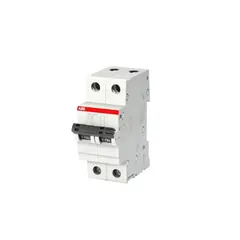
Breaking capacity is the largest fault current the breaker can interrupt safely. It must be at least the prospective short-circuit current at the point of installation, which rises the closer the board is to the supply transformer. On an IEC 60898-1 breaker it appears as a figure in a box, such as 6000 or 10000 (amps), the rated short-circuit capacity Icn. Breakers also marked to IEC 60947-2 state an ultimate capacity Icu and a service capacity Ics for industrial use. 6 kA suits most final circuits in buildings; 10 kA is the safer default in commercial and industrial boards and anywhere the fault level is not known. The ABB SB200M here is rated 10 kA.
Poles: SP, SPN, DP, TP, TPN and FP
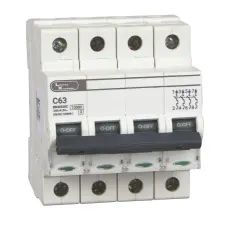
A single-pole (SP or 1P) MCB switches the phase only; SPN or 1P+N adds a switched neutral in the same width; double pole (DP or 2P) switches two conductors together, used for single-phase circuits where both must be isolated; triple pole (TP or 3P) protects a three-phase load with no neutral; TPN (3P+N) and four pole (FP or 4P) switch all three phases and the neutral, which some earthing systems and many specifications require at the incomer. The Lauritz Knudsen Exora 63 A four-pole MCB here is the kind of breaker used as a three-phase incomer or sub-main.
Buying tips
- Size the current rating to protect the cable, not the load: the breaker must be at or below the cable's current-carrying capacity as installed.
- Choose C curve unless there is a reason not to: B for long runs and purely resistive loads, D only for genuinely high inrush.
- When the fault level is unknown, specify 10 kA; the price difference is small next to replacing a board.
- Read both standards on the breaker face: IEC 60898-1 for building installations, IEC 60947-2 where an industrial rating is called for.
- Use DC-rated MCBs for solar strings and battery circuits; an AC breaker's rating does not carry over to DC.
Frequently asked questions
What is the difference between B, C and D curve MCBs?
How much surge they allow before tripping instantly: B at 3 to 5 times the rated current, C at 5 to 10 times, D at 10 to 20 times. The overload (slow) part of the curve is the same; only the instant magnetic trip changes.
Is 6 kA enough or do I need 10 kA?
6 kA covers most final circuits in buildings. Use 10 kA (or higher) in commercial and industrial boards, near the supply transformer, or whenever the prospective short-circuit current has not been calculated.
What do IEC 60898-1 and IEC 60947-2 mean on an MCB?
IEC 60898-1 is the standard for circuit breakers in household and similar installations, rated by Icn. IEC 60947-2 covers industrial circuit breakers, rated by Icu and Ics. Many MCBs are tested to both and carry both sets of markings.
Can I replace a B-curve MCB with a C-curve one?
Only after checking the circuit: a C curve needs about twice the fault current to trip instantly, so on a long run the fault at the far end may not reach it. Where the circuit was designed for B, keep B or have the design rechecked.
Can Elume quote MCBs for a project abroad?
Yes. Send the schedule with ratings, curves, breaking capacity and poles through the export desk, across brands such as ABB, Schneider, Legrand, Lauritz Knudsen and Havells, and we return one consolidated quote within 24 hours.
Compare MRP vs the Elume price across brands, with wholesale prices on 15+ units.
Browse the catalogue →