

DC MCB vs AC MCB: Why the Solar DC Side Needs Its Own Breaker (and How to Size It)
- An AC MCB relies on the current passing through zero 100 times a second to put out the arc. DC never passes through zero, so an AC MCB on a PV string may not interrupt it. Use a breaker rated for DC.
- DC voltage rating must exceed the string's highest Voc, which occurs on the coldest morning: Voc max = modules x Voc x (1 + temperature coefficient x (Tmin - 25)).
- Ten 550 W modules in one string can exceed 500 V DC on a cool morning. That rules out a 500 V DC MCB, so use two strings or an 800-1000 V device.
- Current rating: at least 1.25 x the module's Isc. Many designers use 1.56 x Isc, which gives 25 A for a module with about 14 A Isc.
- Many DC MCBs are polarised. Wire + and - exactly as marked, or the breaking capacity is not guaranteed.
Walk through enough rooftop installations and you will find a DCDB with an ordinary AC MCB in it, put there because it was in the van, the rating matched, and the system switched on fine. It will keep working fine, right up to the day it has to break a DC fault or someone opens it under load. Then it may not break the circuit at all.
This guide explains, in installer's terms, why the DC side needs a DC-rated device, and how to choose its voltage and current ratings from your module datasheet. It includes worked examples for the 3 kW, 5 kW and 10 kW systems that make up most PM Surya Ghar work.
Why AC breakers fail on DC: no current zero
When any breaker opens under load, an arc forms between the separating contacts. On 50 Hz AC the current falls to zero 100 times a second, and the arc goes out at the next zero. An AC MCB's arc chute is designed around that help. Solar DC is a steady current with no zero crossing, so the arc has to be stretched, cooled and blown out by the breaker itself. That takes larger arc chutes, permanent magnets and often several contacts in series. An AC MCB lacks these. Its 230/415 V AC marking says nothing about what it can break at 400 V DC, and in practice that is very little. A breaker for the PV side must carry a DC voltage rating, such as 500 V DC, 800 V DC or 1000 V DC, marked on the device.
Voltage: size for the coldest morning, not the datasheet Voc
Module Voc rises as cell temperature falls. The datasheet value is at 25 C, and a winter sunrise in north India can put cells near 0-5 C. String Voc max = N x Voc(STC) x (1 + beta x (Tmin - 25)), where beta is the Voc temperature coefficient (around -0.25 to -0.30% per degree C for current mono PERC and TOPCon modules; use your datasheet). Example: ten modules with Voc 49.6 V and beta -0.27%/C, at Tmin = 5 C: 10 x 49.6 x (1 + 0.0027 x 20) = about 523 V. That is above 500 V, so a 500 V DC MCB is not suitable for this string even though the STC figure (496 V) looks fine. The DC MCB, the DC isolator and the PV surge protector must all be rated above this cold-weather Voc. Our free rooftop BOM template does this calculation for you.
Current: 1.25 to 1.56 x Isc, and know when string protection is needed
Size a string's DC breaker or fuse at no less than 1.25 x the module short-circuit current (Isc), so it does not nuisance-trip on bright, cold days. Many designers use 1.56 x Isc (1.25 x 1.25) to allow for irradiance above the STC 1,000 W/m2. For a module with Isc around 13.9 A that gives about 17-22 A, so a 20 A or 25 A DC breaker. Stay below the module's maximum series fuse rating on the datasheet. Strictly, overcurrent protection on each string is required when three or more strings are in parallel. With one or two strings, the DC device mainly serves as a load-break disconnect for isolation. Most Indian DCDB specifications still call for a DC MCB or fuse per string, so follow your DISCOM or tender specification.
3 kW and 5 kW single-phase: a combo AC + DC MCB set
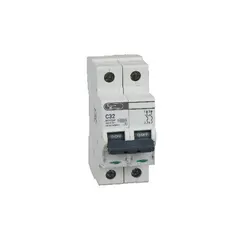
A typical 3 kW system with six 545-550 W modules in one string has a cold Voc around 310-320 V, well inside a 500 V DC rating. On the AC side, a 3 kW single-phase inverter delivers about 13 A, so a 20 A double-pole AC MCB fits. L&K's Exora Solar Combo puts both in one pack: a 20 A DP C-curve AC MCB plus a 32 A DP 500 V DC MCB, matched for small rooftop DCDB and ACDB builds. For 5 kW (about 22 A AC), the 32 A AC + 25 A DC combo covers the AC side and one string. Use it only where each string's cold Voc stays below 500 V, which usually means two strings of five rather than one string of ten, and add a second DC-rated MCB for the second string.
Longer strings and 10 kW: 800 V or 1000 V DC devices
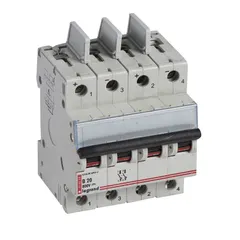
Once strings run past about nine modules, or the inverter accepts 1000 V input as many three-phase 10 kW units do, move to higher-voltage DC devices. Legrand's DX3 Photovoltaic range includes 800 V DC MCBs, such as this 20 A unit, and 1000 V DC versions, plus DC rotary isolators rated 600 V and 1000 V. They cost more than 500 V devices, but they are the correct part. An under-rated DC voltage is one of the most common DCDB mistakes.
Polarity: DC MCBs are often one-way devices
Many DC MCBs use a permanent magnet to drive the arc into the chute. Wired backwards, the magnet pushes the arc the wrong way and the rated breaking capacity no longer applies. These breakers are marked with + and - terminals and a line-to-load direction. Follow the marking exactly, and check it during your pre-commissioning inspection on every DCDB. It is a five-second check that is often skipped.
Buying tips
- Calculate cold-weather Voc for every string from the actual module datasheet and your site's record low temperature before choosing any DC device.
- Match the DC MCB, DC isolator and PV SPD voltage ratings to the same cold Voc. One under-rated device undermines the others.
- For bifacial modules, check the datasheet Isc including the bifacial gain before sizing the DC breaker.
- Never substitute an AC MCB on the PV side, even temporarily. Mark the DCDB clearly so maintenance staff do not swap it later.
- Standardise your DCDB for 3, 5 and 10 kW, and buy those parts in sets. Wholesale pricing on Elume applies from 15 units of the same item.
Frequently asked questions
Can I use an AC MCB for solar DC?
No. AC MCBs rely on the current zero crossing to put out the arc, and DC has none. Use a breaker with a marked DC voltage rating above your string's cold-weather Voc.
What DC MCB rating do I need for a 5 kW solar system?
It depends on the string layout. With two strings of five 550 W modules, cold Voc is about 260-270 V per string and a 500 V DC, 25 A MCB is suitable. With one string of ten, cold Voc can exceed 500 V and you need an 800 V or 1000 V DC device.
How do I calculate maximum string voltage?
Voc max = number of modules x module Voc at STC x (1 + temperature coefficient x (minimum temperature - 25)). Use the coefficient from the module datasheet, as a negative number per degree C.
Why does my DC MCB have + and - markings?
It is a polarised DC breaker. Its arc-quenching design depends on current direction, so it must be wired as marked to achieve its breaking capacity.
Is a DC MCB required if there is only one string?
Overcurrent protection per string is technically needed only with three or more parallel strings, but a DC-rated disconnect is always needed. Most Indian DCDB specifications include a DC MCB or fuse anyway. Follow your DISCOM's specification.
Compare MRP vs the Elume price across brands, with wholesale prices on 15+ units.
Browse the catalogue →