

How to Calculate the Cost of Building an APFC Panel (Worked 50 kVAr Example)
- Required kVAr = kW x (tan phi1 - tan phi2). Lifting 100 kW from 0.80 to 0.95 PF needs about 42 kVAr delivered.
- Capacitors rated 440 V on a 415 V system deliver only (415/440) squared, about 89% of nameplate. So 42 kVAr needed means about 47 kVAr nameplate, and you would build 50.
- A 50 kVAr, 4-step panel (5 + 10 + 15 + 20) needs four capacitors, four capacitor-duty contactors, a PF controller, step protection and an incomer. On our listed prices that core comes to about Rs 86,000 including GST.
- Add the enclosure, busbars, CTs, wiring and labour from your own costing. Those are not in the catalogue figure.
- If the site has drives or other harmonic loads, budget for a detuned design (7% reactors with suitably rated capacitors). It changes the cost a lot.
APFC panels are one of the most quoted products in Indian panel shops, because every industrial unit on an HT or LT industrial tariff is billed on power factor in some form. They are also one of the most commonly mis-estimated. The estimate uses the nameplate kVAr, ignores the voltage derating, sizes the steps badly, and leaves out the step protection, so the margin on the job disappears during execution.
This guide walks through the sizing calculation, how to split the steps, and a line-by-line component cost for a common 50 kVAr, 4-step panel. Every catalogue line links to a part we list, so you can price your own variant at live prices. Prices quoted are Elume's listed prices including GST on 17 November 2026.
Step 1: size the kVAr from the load and target power factor
The required reactive power is Q = P x (tan phi1 - tan phi2), where P is the active load in kW, phi1 is the angle at the present power factor and phi2 the angle at the target. Take a factory with 100 kW average load at 0.80 PF that wants 0.95. tan(acos 0.80) = 0.750 and tan(acos 0.95) = 0.329, so Q = 100 x 0.421 = about 42 kVAr. Use the electricity bill or a power analyser logging over a few days to get P and the present PF. Do not use the connected load. Size to the average load with steps that can follow the variation, not to the peak.
Step 2: correct for capacitor voltage, the step most estimates miss
Capacitor output varies with the square of the applied voltage: Q actual = Q rated x (V system / V rated) squared. Capacitors for Indian LT panels are usually rated 440 V for durability, so on a 415 V bus each one delivers (415/440) squared = 0.89 of its nameplate. To get 42 kVAr delivered you need about 47 kVAr of nameplate, and a practical build is 50 kVAr. Heavy-duty capacitors such as this Legrand Alpx3 10 kVAr box type (440 V) are the usual choice for industrial duty, and standard-duty units cost less where switching is light and the supply is clean.
Step 3: choose steps the controller can combine
Steps of 5 + 10 + 15 + 20 kVAr let the controller build any total from 5 to 50 in 5 kVAr increments, which follows a varying load far better than two 25 kVAr steps. Use a controller with a couple of spare steps for future expansion. Here, this Legrand Alpx3 6-step controller was actually cheaper on our list than the 4-step model, so it is the better buy. The controller needs a CT on one phase of the main incoming supply, upstream of both the load and the capacitor bank, with the voltage taken from the other two phases. Check the controller manual for the exact CT and voltage phase arrangement, because wiring it wrong is the most common commissioning fault.
Step 4: capacitor-duty contactors, not standard ones
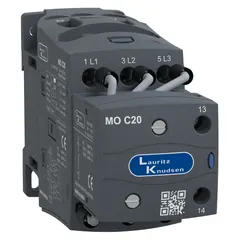
Switching a capacitor causes a very high inrush current. Capacitor-duty contactors have early-make contacts with damping resistors that limit it. A standard AC-3 contactor in this duty will weld or wear quickly. They are rated directly in kVAr at 440 V, so you match each one to its step: L&K's MO C range covers 3 to 100 kVAr, such as this MO C20 for the 20 kVAr step. Steps 5, 10 and 15 use the MO C5, MO C10 and MO C15.
Step 5: step protection and the incomer
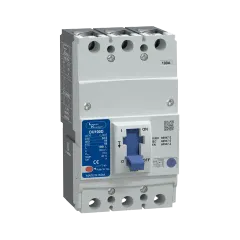
Capacitor current at 440 V is about 1.31 A per kVAr (I = kVAr x 1000 / (1.732 x 440)). Protect each step at about 1.5 times its rated current to allow for harmonics and tolerance. That gives roughly 10 A for the 5 kVAr step, 20 A for 10 kVAr, 32 A for 15 kVAr and 40 A for 20 kVAr, using three-pole MCBs or HRC fuses as your design standard requires. The 50 kVAr bank draws about 66 A at nameplate, so a 100 A MCCB is a sound incomer. This L&K DU100D (100 A, 18 kA) is one option. Choose its breaking capacity from the site fault level.
The worked cost: about Rs 86,000 of catalogue components
At Elume's listed prices including GST on 17 November 2026, the 50 kVAr, 4-step core comes to about Rs 86,260. Capacitors: Legrand Alpx3 heavy-duty box 5, 10, 15 and 20 kVAr = Rs 34,122. Capacitor-duty contactors: L&K MO C5, C10, C15 and C20 = Rs 17,945. Controller: Legrand Alpx3 6-step = Rs 19,773. Step MCBs: Legrand DX3 3P C-curve 10, 20, 32 and 40 A = Rs 8,482. Incomer: L&K DU100D 100 A MCCB = Rs 5,935. Add from your own costing the enclosure and busbars, the CT, the cooling fan and louvres, the wiring and terminals, testing and labour. Treat this as a template: change the steps or brands in our free APFC costing sheet and the totals update. Prices change, so confirm them live before you quote.
When the cost doubles: harmonics and detuned panels
If the site has drives, UPS systems, rectifiers or many LED drivers, plain capacitors can resonate with the transformer and amplify harmonics, which shortens capacitor life and can trip breakers. The usual answer is a detuned panel: a series reactor (commonly 7% or 14%) on each step, with capacitors rated for the higher voltage the reactor causes. Reactors such as this Legrand 7% 25 kVAr unit cost more than the capacitor they protect. Use the manufacturer's matched reactor and capacitor pairs, and ask for a harmonic measurement before you quote a plain panel to an industrial client.
Buying tips
- Ask the client for six to twelve months of bills. The PF trend and the billed kVAh against kWh tell you more than a single site visit.
- Quote delivered kVAr, not nameplate kVAr, and state the capacitor voltage rating. It avoids arguments at handover.
- Never use standard contactors for capacitor steps. Capacitor-duty contactors cost slightly more and prevent welded contacts.
- Leave controller steps and panel space for at least one future step. Load grows, and a later step is an easy repeat order.
- Check whether harmonics are present before quoting a plain (non-detuned) panel to a site with VFDs.
Frequently asked questions
How do you calculate kVAr for an APFC panel?
kVAr = kW x (tan phi1 - tan phi2), where phi1 and phi2 are the angles at the present and target power factors. Then divide by (system voltage / capacitor rated voltage) squared, about 0.89 for 440 V capacitors on 415 V, to get the nameplate kVAr.
What is the cost of a 50 kVAr APFC panel?
The main catalogue components (four heavy-duty capacitors, four capacitor-duty contactors, a 6-step controller, step MCBs and a 100 A MCCB incomer) come to about Rs 86,000 including GST at Elume's 17 November 2026 prices. Enclosure, busbars, CTs, wiring and labour come on top and depend on your shop.
Why use 440 V capacitors on a 415 V system?
For voltage headroom and longer life. Supply voltage often runs above nominal, and harmonics raise peak voltage. The cost is lower output: about 89% of nameplate at 415 V.
Do I need a capacitor-duty contactor?
Yes. Capacitor switching inrush can be many times the rated current. Capacitor-duty contactors include pre-charge resistors and early-make contacts that limit it. Standard contactors weld or wear quickly in this duty.
When is a detuned APFC panel needed?
When the site has significant harmonic-producing loads such as drives, UPS systems or rectifiers. Series reactors tuned below the dominant harmonic stop the capacitors resonating with the network. Measure the harmonics before deciding.
Compare MRP vs the Elume price across brands, with wholesale prices on 15+ units.
Browse the catalogue →